Deploying Open Weights Models: Gemma 2 vs Llama 3.x vs Qwen-2.5
Performance, license, capability, and fine-tuning benchmarks for enterprise deployments.
In the fast-moving landscape of enterprise artificial intelligence in 2026, the reliance on proprietary third-party APIs is increasingly seen as a strategic risk. Concerns over data privacy, unpredictable API rate limits, vendor lock-in, and the cumulative costs of scale have driven developers to self-hosted models. The open-weights ecosystem has matured to the point where smaller, localized models can achieve comparable, and sometimes superior, reasoning quality on domain-specific tasks.
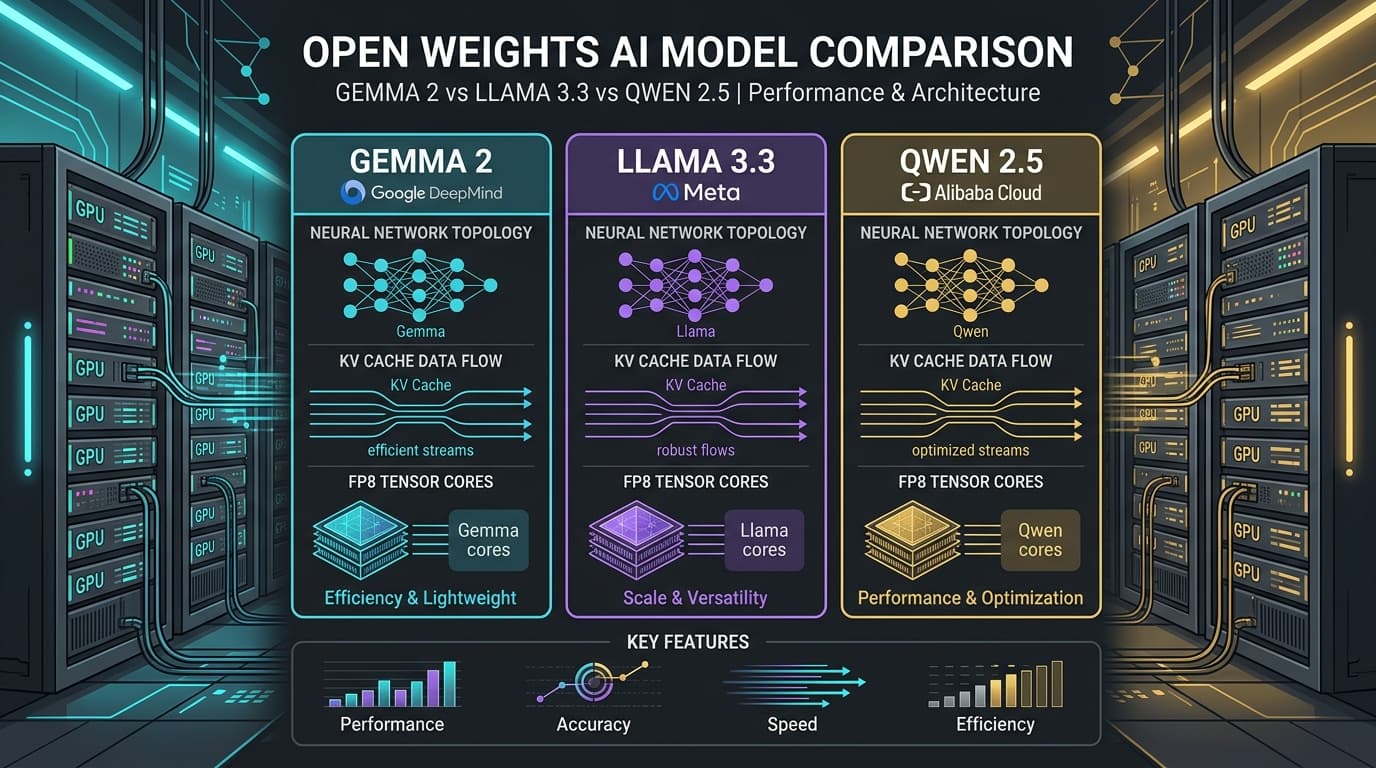
Among the current state-of-the-art open-weights offerings, three model families dominate: Google's Gemma 2, Meta's Llama 3.x (incorporating the 3.1 and 3.2 updates), and Alibaba's Qwen-2.5. Deciding which of these models to standardize on requires looking beyond raw benchmark averages. You must understand their architectural quirks, hardware VRAM footprint, memory caching behaviors, licensing terms, and compatibility with production inference engines.
This guide provides a deep-dive comparison of Gemma 2, Llama 3.x, and Qwen-2.5 to help you size, configure, and deploy the ideal model for your enterprise workloads.
What Is It?
To set the stage, let us define the scope of these three model families. These are "open weights" models rather than fully "open source" in the traditional Open Source Initiative (OSI) sense, because they are distributed with customized, permissive licenses rather than standard OSI-compliant ones. However, the weights are freely downloadable, and the models can be run entirely in private, self-hosted environments.
- Gemma 2 (Google): Google’s lightweight, state-of-the-art open-weights model family, detailed in the Gemma 2 Technical Report. It is built using the same research and technology used to create the Gemini models. The family spans 2B, 9B, and 27B parameter sizes, designed specifically for high-efficiency local execution.
- Llama 3.x (Meta): Meta's flagship open-weights series, including Llama 3.1 and 3.2, introduced in the Llama 3.1 Architecture Technical Paper. Llama 3.1 expanded the context length to 128K and introduced GQA across all sizes (8B, 70B, and 405B), while Llama 3.2 added lightweight edge models (1B and 3B) and vision-capable variants. It represents the industry standard for community integration.
- Qwen-2.5 (Alibaba): Alibaba Cloud's highly optimized model series, as outlined in the Qwen 2.5 Technical Blog. It ranges from edge-friendly sizes (0.5B, 1.5B, 3B, 7B, 14B) to larger enterprise weights (32B, 72B). Qwen-2.5 has gained immense popularity in 2026 due to its exceptional math, coding, and multilingual reasoning capabilities.
Why It Matters
Standardizing on an open-weights model family has direct architectural and economic implications. Selecting the wrong model can lead to bloated GPU cluster costs, slow token throughput, or legal compliance headaches.
- VRAM Allocation: Inference engines like vLLM pre-allocate large portions of GPU memory to host model weights and the Key-Value (KV) cache. If your model's architecture requires a large KV cache, your concurrent user capacity (batch size) will collapse.
- Context Scaling: While a 128K context window is powerful, running a model at full context scales VRAM consumption quadratically unless managed. For example, Llama 3.1 and Qwen-2.5 support 128K, whereas Gemma 2 natively supports an 8K context. For document-heavy applications, leveraging a Retrieval-Augmented Generation (RAG) system with optimized RAG retrieval methods or hierarchical parent-child retrievers is often far more token-efficient than feeding entire files into the context window.
- Domain Specialization: Certain models excel at structured outputs (such as JSON generation for agentic tool use), while others are mathematically superior. Running a general model for coding tasks might require expensive fine-tuning, whereas a specialized model might work out-of-the-box.
- Licensing and Compliance: Enterprises must align model usage with internal legal frameworks. A project using Llama 3.1 must comply with Meta's user threshold limits, whereas Qwen-2.5 offers Apache 2.0 licensing on most variants, simplifying distribution.
How It Works
At a high level, all three model families are decoder-only autoregressive transformers. They generate text token-by-token by predicting the probability distribution of the next token based on all preceding tokens. However, the underlying mathematical layers and architectural configurations differ.
During generation, the attention mechanism must compute relationships between the current token and all previous tokens. To avoid recomputing these vectors at every generation step, the Key and Value representations of past tokens are stored in GPU memory. This is known as the KV Cache.
The efficiency of this cache depends directly on three parameters configured during the model's design:
- Layers (L): The number of transformer block repetitions.
- Key-Value Heads (H_kv): The number of heads dedicated to storing the KV representations.
- Head Dimension (D): The size of the hidden vector per head.
We can estimate the VRAM consumption of the KV Cache per token using the following formula:
KV Cache Memory per Token (Bytes) = 2 * L * H_kv * D * P
where:
2accounts for storing both Key and Value vectors.Lis the number of transformer layers.H_kvis the number of KV heads.Dis the dimension of the head.Pis the precision of the numerical format in bytes (e.g., 2 bytes for FP16 or BF16, 1 byte for FP8, or 0.5 bytes for FP4).
Let's calculate the KV Cache VRAM requirement for a single batch at a sequence length of 8,192 tokens using BF16 precision (P = 2).
For a batch size B, the total cache size is:
Total KV Cache Size (Bytes) = 2 * L * H_kv * D * P * B * S
where S is the sequence length. We will apply this math in the comparison sections below.
Architecture
Let's analyze the structural differences that dictate the operational characteristics of each model.
graph TD
    Engine["vLLM / Inference Engine"] --> Models["Model Family"]
    Models --> Gemma["Gemma 2 (9B)"]
    Models --> Llama["Llama 3.1 (8B)"]
    Models --> Qwen["Qwen 2.5 (7B)"]

    Gemma --> G1["Interleaved SWA / Global Attention"]
    Gemma --> G2["Logit Soft-Capping (50.0 / 30.0)"]
    Gemma --> G3["Head Dimension: 256"]

    Llama --> L1["Global GQA (8 KV Heads)"]
    Llama --> L2["RoPE Base Frequency Scaling"]
    Llama --> L3["Head Dimension: 128"]

    Qwen --> Q1["Highly Efficient GQA (4 KV Heads)"]
    Qwen --> Q2["Dense SwiGLU Activation"]
    Qwen --> Q3["Large Multilingual Vocab (151K)"]
1. Gemma 2: High Density and Soft-Capping
Google's Gemma 2 introduces several unique mechanisms designed to pack high representation capacity into fewer parameters, but this comes with a memory cost.
- Logit Soft-Capping: To prevent training instability and keep probability distributions bounded, Gemma 2 caps attention and final layer logits. The formula applied to logits before the softmax activation is:
For attention layers, thecapped_logits = soft_cap * tanh(logits / soft_cap)soft_capis set to50.0. For the final output layer, it is set to30.0. While this ensures high model stability, it requires custom support in inference kernels to prevent numerical drift. - Interleaved Attention: Gemma 2 alternates every other layer between local sliding window attention (with a span of 4,096 tokens) and global attention (spanning the full 8,192-token window). This reduces the computational overhead of standard self-attention.
- Large Head Dimension: Unlike Llama and Qwen, which standardize on a head dimension of 128, Gemma 2 uses a head dimension of 256. Combined with 42 layers in the 9B variant, Gemma 2 has a significantly heavier KV Cache footprint than its peers.
2. Llama 3.x: The Scalable Standard
Meta's Llama 3.x series is a highly optimized, standard Transformer implementation.
- Grouped-Query Attention (GQA): Llama 3.1 standardizes on GQA across all parameter sizes (8B, 70B, 405B). By grouping 8 query heads to share a single KV head, Llama 3.1 reduces the KV cache size by a factor of 8 compared to Multi-Head Attention (MHA) (for a deeper dive, see our guide on mitigating attention bottlenecks with FlashAttention, MQA, and GQA).
- Expanded Context: The native context window of Llama 3.1 is 128,192 tokens. To handle such a massive range, it utilizes adjusted Rotary Position Embedding (RoPE) base frequencies, scaling the theta parameter from 10,000 to 500,000.
- Optimized Vocabulary: Llama 3.x uses a large vocabulary size of 128,256 tokens. This improves tokenization efficiency, resulting in fewer tokens generated per sentence, reducing overall API latency.
3. Qwen-2.5: The Multilingual Mathematician
Alibaba's Qwen-2.5 is designed for maximal performance on structured data and multilingual capabilities.
- High Efficiency GQA: Qwen-2.5 7B utilizes only 4 KV heads (in contrast to Llama's 8). This gives it the smallest KV cache memory footprint among the mid-sized models, making it ideal for high-throughput API endpoints. Integrated optimizations are supported in the Transformers v5.5.0 Release (May 2026) for dynamic GQA processing.
- Dense Layer Architecture: Qwen-2.5 utilizes a dense decoder-only architecture with SwiGLU activation functions, achieving excellent performance-per-parameter on mathematical and coding benchmarks.
- Massive Scale Versatility: Qwen-2.5 supports context windows up to 128K natively, and with specialized configurations like YaRN (Yet another RoPE scaling method), can scale to processing long documents with minimal latency degradation.
Table 1: Architectural Comparison
| Parameter | Gemma 2 9B | Llama 3.1 8B | Qwen-2.5 7B |
|---|---|---|---|
| Parameters (Active) | 9.2 Billion | 8.03 Billion | 7.61 Billion |
| Number of Layers | 42 | 32 | 28 |
| Attention Heads | 16 | 32 | 28 |
| KV Heads (GQA) | 8 | 8 | 4 |
| Head Dimension | 256 | 128 | 128 |
| Native Context Length | 8,192 | 128,000 | 128,000 |
| Vocabulary Size | 256,000 | 128,256 | 151,643 |
| Logit Soft-Capping | Yes (50.0 / 30.0) | No | No |
| Attention Style | Interleaved (SWA/Global) | Global GQA | Global GQA |
| Base License | Gemma Terms | Llama 3.1 Community | Apache 2.0 |
Production Deployment Considerations
When hosting these models locally or on private cloud servers, VRAM calculation dictates your hardware costs. The VRAM required to deploy an open-weights model consists of two parts:
- Model Weight Memory: The static memory required to load the model parameters.
- KV Cache Memory: The dynamic memory reserved for concurrent processing.
Let us evaluate the memory requirements for each model using the formulas defined earlier. We assume FP16/BF16 precision (2 bytes per weight/token representation) and a batch size of 32 at a sequence length of 8,192 tokens.
VRAM Calculations
1. Gemma 2 9B Sizing
- Model Weights VRAM:
Weight VRAM = 9.2B * 2 bytes = 18.4 GB - KV Cache VRAM (Per Token):
Memory per Token = 2 * 42 (layers) * 8 (KV Heads) * 256 (Head Dim) * 2 bytes = 344,064 Bytes (~344 KB) - Total KV Cache VRAM (Batch 32, 8K Context):
Total KV VRAM = 344,064 * 32 * 8192 = 90,194,313,216 Bytes = 84.00 GB - Minimum VRAM for Deployment (Weights + Cache):
Gemma 2 9B requires more than one 80GB GPU (like an A100 or H100) to serve 32 concurrent requests at an 8K context without quantization!Total VRAM = 18.4 GB + 84.00 GB = 102.40 GB
2. Llama 3.1 8B Sizing
- Model Weights VRAM:
Weight VRAM = 8.03B * 2 bytes = 16.06 GB - KV Cache VRAM (Per Token):
Memory per Token = 2 * 32 (layers) * 8 (KV Heads) * 128 (Head Dim) * 2 bytes = 131,072 Bytes (~131 KB) - Total KV Cache VRAM (Batch 32, 8K Context):
Total KV VRAM = 131,072 * 32 * 8192 = 34,359,738,368 Bytes = 32.00 GB - Minimum VRAM for Deployment (Weights + Cache):
Llama 3.1 8B easily fits into a single 80GB GPU or can be run comfortably on an A10G (24GB) using 8-bit or 4-bit quantization.Total VRAM = 16.06 GB + 32.00 GB = 48.06 GB
3. Qwen-2.5 7B Sizing
- Model Weights VRAM:
Weight VRAM = 7.61B * 2 bytes = 15.22 GB - KV Cache VRAM (Per Token):
Memory per Token = 2 * 28 (layers) * 4 (KV Heads) * 128 (Head Dim) * 2 bytes = 57,344 Bytes (~57.3 KB) - Total KV Cache VRAM (Batch 32, 8K Context):
Total KV VRAM = 57,344 * 32 * 8192 = 15,032,385,536 Bytes = 14.00 GB - Minimum VRAM for Deployment (Weights + Cache):
Qwen-2.5 7B has the lowest memory requirement, making it highly suitable for high-density, multi-tenant deployments on cost-effective hardware.Total VRAM = 15.22 GB + 14.00 GB = 29.22 GB
Table 2: Benchmark and Performance Summary
| Benchmark | Gemma 2 9B | Llama 3.1 8B | Qwen-2.5 7B |
|---|---|---|---|
| MMLU (General) | 77.2% | 73.0% | 74.2% |
| HumanEval (Code) | 52.4% | 72.6% | 86.6% |
| MATH (Math) | 35.8% | 29.8% | 61.2% |
| GPQA (Graduate-level Reasoning) | 22.0% | 25.1% | 28.5% |
| Multilingual Performance | Moderate | High | Very High |
| Tool Calling / JSON Extraction | Moderate | Very High | High |
These benchmarks correspond to recent evaluations, including the LMSYS Chatbot Arena June 2026 Leaderboard Update (June 2026), showing Qwen-2.5 Coder leading in code generation tasks while Llama 3.1 and Gemma 2 stay neck-and-neck in standard conversational English reasoning.
Production Deployment Blueprints
To serve these models at scale with high throughput, developers rely on optimized serving libraries. The industry standard is the vLLM Serving Engine, which utilizes continuous batching and pagedattention to eliminate internal fragmentation in the KV cache. The recent vLLM v0.22.0 Release (May 2026) introduced a DFlash attention backend and sparse GQA indexer optimizations. Additionally, the highly performant SGLang v0.5.10 Release (June 2026) offers day-0 support for many of these newer weights with advanced speculative decoding optimizations. vLLM's memory management also heavily relies on PyTorch's backend allocator, which received extensive CUDA graph updates in the PyTorch v2.12.0 Release (May 2026).
Below are step-by-step blueprints for deploying these models in a Docker environment.
vLLM Deployment Compose File
Create a docker-compose.yml to serve the models over an OpenAI-compatible HTTP API.
version: '3.8'

services:
  vllm-server:
    image: vllm/vllm-openai:latest
    container_name: vllm-inference
    environment:
      - HUGGING_FACE_HUB_TOKEN=your_hugging_face_token
    ports:
      - "8000:8000"
    volumes:
      - ~/.cache/huggingface:/root/.cache/huggingface
    deploy:
      resources:
        reservations:
          devices:
            - driver: nvidia
              count: 1
              capabilities: [gpu]
    command: >
      --model Qwen/Qwen2.5-7B-Instruct
      --port 8000
      --gpu-memory-utilization 0.90
      --max-model-len 32768
      --trust-remote-code
vLLM Deployment Optimization Parameters
When serving different models, specific CLI arguments must be tuned to prevent Out-Of-Memory (OOM) failures or performance degradation:
- For Gemma 2 9B:
Due to the huge KV cache footprint calculated above, you must limit the maximum context length or force FP8/INT8 quantization when using standard GPUs:
Settingpython3 -m vllm.entrypoints.openai.api_server \ --model google/gemma-2-9b-it \ --max-model-len 8192 \ --gpu-memory-utilization 0.95 \ --kv-cache-dtype fp8--kv-cache-dtype fp8reduces the KV cache size by 50% by storing cache tensors in 8-bit format, bringing the required VRAM down to manageable levels. - For Llama 3.1 8B:
Llama 3.1 has a native context length of 128K. If you run it with default configurations, vLLM will allocate a massive KV Cache block, leading to instant OOMs on 24GB or even 48GB GPUs. You must override the maximum context length:
python3 -m vllm.entrypoints.openai.api_server \ --model meta-llama/Llama-3.1-8B-Instruct \ --max-model-len 32768 \ --gpu-memory-utilization 0.90 - For Qwen-2.5 7B:
Qwen-2.5 supports 128K context natively and features low cache overhead. It is the most flexible model to run. You can configure vLLM to scale the context length based on hardware availability:
python3 -m vllm.entrypoints.openai.api_server \
  --model Qwen/Qwen2.5-7B-Instruct \
  --max-model-len 65536 \
  --gpu-memory-utilization 0.92
Common Mistakes
When deploying open-weights models, engineers frequently make the following mistakes, leading to degraded accuracy or high operational costs:
- Leaving Context Length Uncapped: Accepting the default
max_model_lenof 128K for Llama 3.1 or Qwen-2.5 on a single GPU. vLLM pre-allocates cache blocks for that length, leaving no room for batch concurrency. Always set--max-model-lento your actual application limit (e.g., 8,192 or 16,384). - Neglecting Logit Soft-Capping Kernels: Deploying Gemma 2 with older inference engines that do not support soft-capping. Without this calculation, logits blow up, resulting in gibberish text or repetitive loops.
- Ignoring Tokenizer Efficiency: Comparing models purely by token-per-second generation speeds. Because Llama 3.x and Qwen-2.5 have larger vocabularies, they represent the same text using fewer tokens than Gemma 2. A model generating 40 tokens per second with a large vocabulary might output text faster than a model generating 50 tokens per second with a small vocabulary.
- Improper Quantization Formats: Using GGUF in high-throughput API services. GGUF is optimized for CPU/GPU hybrid offloading (e.g., local LLM execution with llama.cpp or llama.cpp GPU offloading). For local development or resource-constrained edge testing, frameworks like the Ollama v0.30.2 Release (June 2026) simplify execution of GGUF quantized models with improved GPU offloading kernels. For production API endpoints with concurrent batches, use GPTQ or AWQ formats (see quantization mathematics) which are highly optimized for parallel CUDA execution.
Lessons From Production Deployments
Operating these models in production yields several critical insights:
- FP8 Quantization is a Free Lunch: Storing weights or the KV Cache in FP8 precision (specified in the FP8 Quantization Format Specification) results in a
<1%loss in reasoning accuracy on benchmarks like MMLU, but reduces weight memory by 50%. This enables running Llama 3.1 8B with a 32K context on cost-effective GPUs like the NVIDIA A10G (24GB VRAM). - RoPE Scaling Inconsistencies: When scaling Llama 3.1 beyond 32K context, the default RoPE scaling can lead to attention degradation unless fine-tuned. For document retrieval tasks, ensure your prompt puts the critical context at the beginning or end of the context block, as attention models still exhibit a "loss in the middle" bias.
- Docker VRAM Overhead: Always leave a VRAM buffer (around 5% to 8%) for PyTorch CUDA context initialization inside Docker. Setting
gpu_memory_utilizationto1.0will crash your container during startup because CUDA requires memory to initialize kernels. Additionally, security and compliance protocols should account for the recent vLLM Security Advisory CVE-2026-22778 (April 2026) when loading video or multimodal components in Docker. - Cold Start Latency: Loading model weights from local SSDs to GPU VRAM takes time. Gemma 2 9B takes around 15–20 seconds to load, while Qwen 2.5 7B loads in under 10 seconds on PCIe Gen 4 nvme drives. Implement proper readiness probes in Kubernetes to avoid routing traffic to containers before weights are fully loaded.
What Most Articles Miss
Many comparison reviews summarize HuggingFace leaderboards and suggest choosing the model with the highest average score. However, this advice misses the operational trade-offs and structural implications of deploying these models:
1. The VRAM-to-Parameter Ratio
Gemma 2 9B is labeled as a "9B" model, but because of its 42 layers, 256 head dimension, and interleaved attention layers, its active KV Cache memory requirement is six times larger than Qwen-2.5 7B. If your application handles long-running chats (high batch size, long context), deploying Gemma 2 9B will require scaling your GPU count significantly faster than Qwen-2.5 7B, even though the parameter difference is only 2B.
2. Parameter-Efficient Fine-Tuning (PEFT) Complications
Gemma 2’s logit soft-capping requires specialized configuration during training. Standard LoRA or QLoRA adapters (as detailed in PEFT: LoRA, QLoRA, and AdaLoRA) will fail to converge if the trainer does not account for soft-capping scale constants, leading to loss explosions during backpropagation. Llama 3.1 and Qwen-2.5 do not suffer from this issue, making them much easier to fine-tune using standard templates.
3. Licensing Restrictions in SaaS Distribution
While Qwen-2.5 is built by Alibaba, the model weights for Qwen-2.5 7B, 14B, and 72B are licensed under Apache 2.0. This allows SaaS platforms to bundle the weights directly inside proprietary software products without reporting user numbers. This showcases the rapid rise of hyper-cost-efficient Chinese models that are challenging Silicon Valley's closed API paradigm, which we explore in our analysis of the US vs. China AI battle. Llama 3.1, on the other hand, restricts free commercial use if your application exceeds 700 million monthly active users, which can introduce legal review hurdles for scale-ups.
Table 3: License and Commercial Comparison
| Metric | Gemma 2 | Llama 3.1 / 3.2 | Qwen-2.5 |
|---|---|---|---|
| License Type | Custom (Gemma Terms) | Custom (Llama Community) | Apache 2.0 |
| Commercial Use | Allowed | Allowed (with restrictions) | Allowed (unrestricted) |
| User Threshold | None | Free up to 700M monthly users | None |
| Derived Model Restriction | No | Cannot use to train other models | No |
| Source Code Availability | Yes | Yes | Yes |
Best Practices
To maximize performance and minimize infrastructure costs when deploying open-weights models:
- Quantize the KV Cache: Always run vLLM with
--kv-cache-dtype fp8when using NVIDIA Hopper (H100) or Ada Lovelace (L4/L40S) architectures to double execution concurrency. - Align Vocabularies with Prompts: Llama 3.1’s 128K vocabulary is highly efficient for English text. If your workload involves processing tabular data, JSON files, or multilingual formats, use Qwen-2.5, which has a 151K vocabulary optimized for structured syntax, reducing prompt token count by up to 15%.
- Deploy behind a Load Balancer: Use the LiteLLM Load Balancing Proxy or an Nginx reverse-proxy to route requests across multiple vLLM instances. This allows you to perform rolling updates and model swaps without downtime.
- Incorporate Guardrails Early: Implement validation checkers (such as Llama-Guard or NeMo Guardrails) before routing inputs to the main model. This prevents prompt injections and ensures output compliance (see guardrails in production LLM validation and prompt injection mitigation defenses).
FAQ
1. Can I run Gemma 2 9B on a single NVIDIA A10G (24GB)?
Yes, but you must use quantization. At FP16, the model weights (18.4GB) leave only 5.6GB for the KV Cache, restricting sequence length and concurrency. Running Gemma 2 9B in AWQ 4-bit mode reduces weight memory to ~5.5GB, leaving plenty of VRAM for cache blocks.
2. Which model is best for coding and structured JSON generation?
Qwen-2.5 dominates coding benchmarks (HumanEval: 86.6% vs Llama 3.1: 72.6%). However, Llama 3.1 is highly optimized for system prompt instructions and agentic tool-calling. If you require raw code output, choose Qwen-2.5. If you require reliable schema orchestration, Llama 3.1 is highly robust.
3. Does Qwen-2.5 support function calling?
Yes, Qwen-2.5 has built-in tool-calling support, and its chat templates natively format function calls, which are compatible with OpenAI’s structured output API.
4. What is logit soft-capping, and does it slow down inference?
Logit soft-capping is a mathematical scaling method to prevent logits from growing infinitely. While it adds a small activation function (tanh) during inference, modern engines like vLLM run optimized Triton kernels that execute this with <1% latency overhead.
5. Why is GQA so important for serving LLMs?
Grouped-Query Attention allows the model to share key-value matrices across multiple attention heads. This reduces the size of the KV cache by 86% compared to Multi-Head Attention, allowing you to run much larger batches on the same GPU.
6. Can I use Llama 3.1 weights to train a proprietary model?
Meta's community license prohibits using Llama outputs to improve or train other models if those models compete with Meta. If you are training a proprietary internal model, Qwen-2.5 (Apache 2.0) is a safer data source.
7. What is the difference between sliding window attention and global attention in Gemma 2?
Sliding window attention only looks at local tokens (e.g., the last 4,096 tokens), reducing computational complexity. Global attention looks at all tokens in the context window. Gemma 2 interleaves these layers to balance memory speed with global context retention.
8. Which model has the fastest cold-start times?
Qwen-2.5 7B has the smallest weight size (~15GB at FP16) and loads faster than Gemma 2 9B (~18GB) or Llama 3.1 8B (~16GB) on NVMe storage.
9. Can I run these models on AMD GPUs?
Yes, vLLM supports ROCm for AMD Instinct GPUs (like the MI210 and MI300 series). All three models run natively on AMD under vLLM ROCm containers.
10. How do I choose between Qwen-2.5 7B and 14B?
If your VRAM is limited to a single 24GB GPU, Qwen-2.5 7B is the best choice. If you have access to an 80GB GPU or can run a 2-GPU tensor parallel setup, Qwen-2.5 14B offers a significant increase in reasoning quality while keeping the KV cache footprint manageable.
Key Takeaways
- KV Cache Footprint Dictates Concurrency: Gemma 2 9B’s large head dimension (256) and 42 layers make its KV Cache six times larger than Qwen-2.5 7B. This significantly restricts concurrent batch processing unless FP8 cache quantization is enabled.
- Qwen-2.5 Leads in Technical Reasoning: Qwen-2.5 7B outperforms both Llama 3.1 8B and Gemma 2 9B in mathematical reasoning (61.2% on MATH) and coding tasks (86.6% on HumanEval).
- Llama 3.1 is the Standard for Agentic Workflows: Llama 3.1 remains the industry standard due to its broad ecosystem support, robust tool-calling integration, and 128K context window.
- Quantization is Critical for Production: Running models in FP16 is highly inefficient. Storing model weights and KV Cache in FP8 or INT4 precision reduces VRAM requirements by over 50% with minimal loss in accuracy.
- Apache 2.0 Licensing Simplifies Compliance: Qwen-2.5's Apache 2.0 license offers the most permissive terms for SaaS distribution, removing Meta's user threshold limits and derived-model restrictions.