The US vs. China AI Rivalry: Heavy Infrastructure vs. Hyper-Cost-Efficiency
How Chinese open-weights models like DeepSeek and Qwen are challenging Silicon Valley's premium compute paradigm — and why the performance gap has collapsed to just 2.7%.

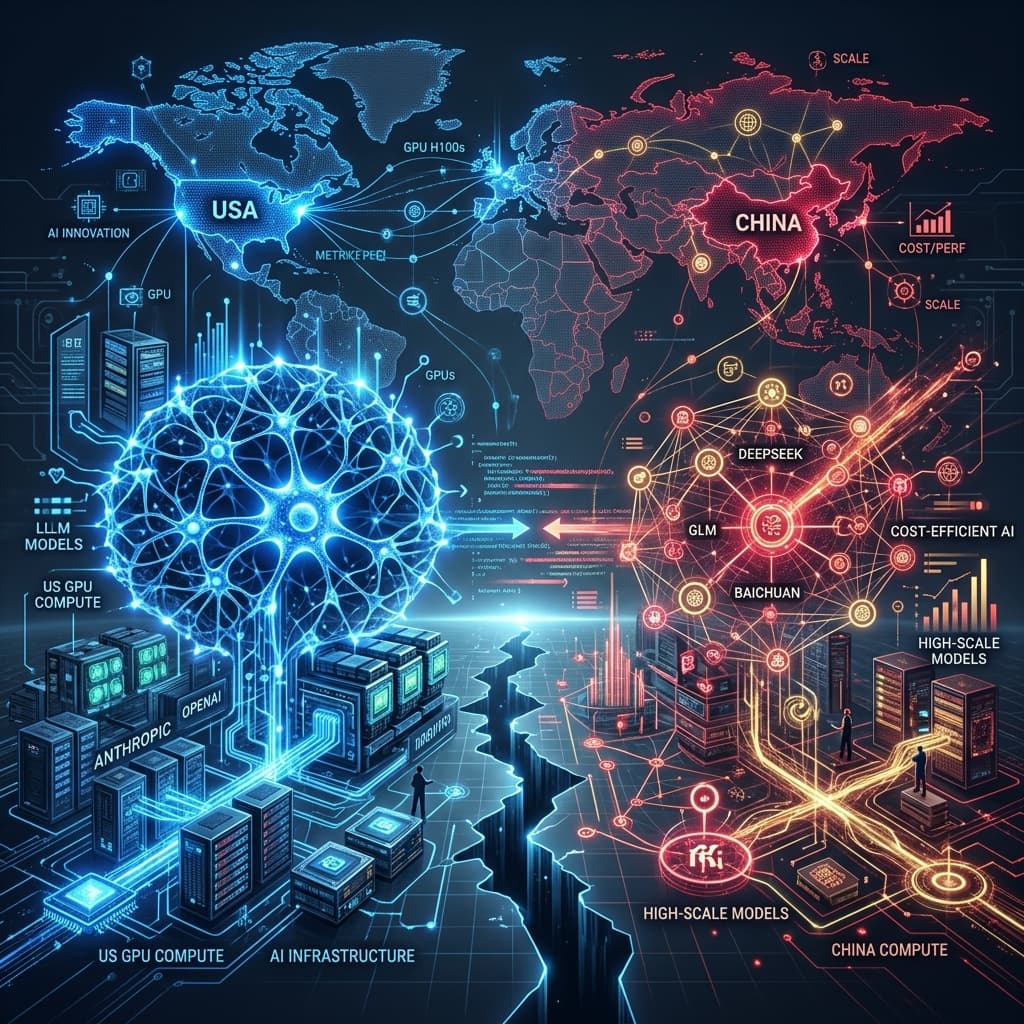
The global Artificial Intelligence landscape has undergone a tectonic shift. For years, Silicon Valley held an unquestioned monopoly on cutting-edge AI breakthroughs—armed with unlimited venture capital, exclusive access to hundreds of thousands of NVIDIA GPUs, and elite research labs like OpenAI, Anthropic, and Google DeepMind.
That era is over. As of mid-2026, the performance gap between the best American and Chinese AI models has collapsed from 31% in 2023 to just 2.7% (Stanford AI Index 2026). Chinese AI developers—led by DeepSeek, Alibaba (Qwen), and Zhipu AI (GLM)—have not only closed the intelligence gap but fundamentally disrupted the economics of AI inference, offering frontier-class models at 10–30x lower cost than their American counterparts.
Let's break down the technical, economic, and geopolitical dynamics of this global AI battleground as it stands today.
🇺🇸 The United States: Frontier Scale & Rapid Iteration
The American AI strategy continues to rely on massive compute scale, but 2025–2026 has seen a dramatic acceleration in release cadence and architectural innovation.
The Current US Model Landscape (June 2026):
-
OpenAI — GPT-5.5 (April 2026): A ground-up architecture rebuild featuring "adaptive thinking"—the model decides in real-time whether to give a quick response or engage in deep multi-step reasoning. GPT-5.3-Codex remains the flagship for autonomous software engineering. OpenAI has shifted from major singular releases to rapid, continuous deployment.
-
Anthropic — Claude Opus 4.8 (Late May 2026): The current frontier model for reliability and autonomous agentic tasks. Introduced "dynamic workflows" in Claude Code—capable of planning and running hundreds of parallel subagents in a single session with effort control for reasoning depth/latency/cost tradeoffs.
-
Google — Gemini 3.5 Flash & Gemini Omni (May 2026, Google I/O): Flash dominates cost-efficient agentic workflows. Omni is a true "world model" with native multimodal I/O (text, audio, image, video) that can simulate physical environments.
-
xAI → SpaceXAI — Grok 4.3: After xAI folded into SpaceX in May 2026, Grok 4.3 became the current flagship, with 4.4 and 4.5 in the pipeline scaling toward trillion-parameter architectures. Grok 3 was trained on Colossus—a 200,000 NVIDIA H100 GPU supercomputer—and retired from the API on May 15, 2026.
-
Meta — Llama 4 (April 2025): Scout (109B/17B active, 10M context) and Maverick (400B/17B active, 1M context). Meta's pivot to MoE architecture marks a philosophical shift—even the US open-source champion now embraces efficiency-first design.
Key Pillars of the US Ecosystem:
- Unrivaled Compute Infrastructure: Tech giants operate massive data centers—over 5,400 in the US alone—housing clusters of NVIDIA Blackwell GPUs and Google TPUs. Global data center power capacity has hit 29.6 GW, roughly equivalent to Switzerland's total electricity consumption.
- Massive Capital Deployment: Private US AI investment reached $285.9 billion in 2025 (23x China's figure). Federal AI contracts in 2026 carry a potential value of $91.8 billion.
- Rapid Model Iteration: The era of annual flagship releases is over. OpenAI, Google, and Anthropic now ship model updates on a near-monthly cadence.
🇨🇳 China: Algorithmic Sovereignty & Ultra-Low Operating Costs
Chinese labs have approached the scaling bottleneck from a completely different angle. Denied access to top-tier NVIDIA hardware by US export controls, they were forced to answer a critical question: How do we achieve frontier-level intelligence at a fraction of the operational cost?
The answer has reshaped the entire global AI economy.
The Current Chinese Model Landscape (June 2026):
-
DeepSeek — V4 (March/April 2026): The current flagship featuring a novel "Engram" memory architecture for superior information retention across long interactions, with a 1M token context window. V4 Pro received a permanent 75% API price cut in May 2026, intensifying the global AI price war. DeepSeek's R1 reasoning model—released in January 2025—was widely called China's "Sputnik moment" for AI.
-
Alibaba — Qwen 3.7-Max: A closed-weight, 1T+ parameter model designed for autonomous enterprise agents. Alibaba runs a full-stack approach (chips, cloud, models) with Apache 2.0 licensing on open-weight versions spanning edge to frontier.
-
Zhipu AI — GLM-5: The latest in the ChatGLM series, optimized for complex systems engineering with an MIT license. A backbone of the Asian enterprise market.
-
Moonshot AI — Kimi K2.6: Specialized for long-horizon agentic engineering tasks, achieving strong performance on SWE-bench coding benchmarks.
-
ByteDance — Doubao/Seed 2.0: Massive consumer scale through Douyin/TikTok integration—one of China's most-used AI apps in Q1 2026.
-
Baidu — ERNIE 5.0: Embeds AI agents directly into search and Baidu Cloud.
-
Tencent — Hunyuan 2.0: Deep integration within the WeChat ecosystem, leveraging its 1B+ user base for distribution.
The Math Behind Chinese Hyper-Efficiency:
The cost disruption is staggering. Here's how API costs compare per million tokens as of June 2026:
| Model Provider | Type | API Input Cost (Per 1M Tokens) | API Output Cost (Per 1M Tokens) |
|---|---|---|---|
| GPT-5.5 (OpenAI) | US Dense (Closed) | $2.50 | $10.00 |
| Claude Opus 4.8 | US Dense (Closed) | $3.00 | $15.00 |
| Llama 4 Maverick (Hosted) | US MoE (Open) | $2.00 | $6.00 |
| DeepSeek V4 Pro | Chinese MoE (Open) | $0.035 | $0.07 |
| GLM-5-Flash | Chinese Dense (Open) | $0.00 (Free Tier) | $0.00 |
After the May 2026 price cut, DeepSeek V4 Pro is roughly 70x to 100x cheaper than equivalent American proprietary APIs. This cost structure is a game-changer for startups deploying agentic workflows that consume millions of tokens daily.
🧠 Architectural Differences: Scaling vs. Optimization
The massive pricing gap isn't just about labor costs or subsidies—it is driven by profound algorithmic differences in model architecture.
graph TD
    subgraph US Paradigm: Dense Scale
        A[Dense Neural Network] -->|All Parameters Active| B[NVIDIA Blackwell Clusters]
        B -->|High Compute Cost| C[Peak Proprietary Intelligence]
    end
    subgraph China Paradigm: Ultra-Optimization
        D[Mixture-of-Experts MoE] -->|Only 5-10% Active Per Token| E[Multi-head Latent Attention MLA]
        E -->|FP8/FP4 Precision + Engram Memory| F[Ultra-Low Cost Inference]
    end
1. Mixture-of-Experts (MoE) vs. Dense Layers
American flagship models historically rely on large, dense structures where every single parameter is activated for every token generated. Chinese models—and increasingly, US open-source models like Llama 4—heavily utilize MoE. DeepSeek's V4 architecture contains 671B total parameters but activates only ~37B per token, keeping 90%+ of the model dormant. This directly scales down the FLOPs required per token by an order of magnitude.
2. Multi-head Latent Attention (MLA)
During text generation, traditional transformers store a "KV Cache" in GPU memory to remember conversation history, which quickly consumes VRAM and limits concurrent users per GPU. DeepSeek's MLA compresses this cache by over 90%, allowing servers to process massive concurrent batches on significantly less GPU memory.
3. Group Relative Policy Optimization (GRPO)
DeepSeek R1 introduced GRPO—a novel reinforcement learning technique that enables advanced reasoning capabilities without requiring massive reward models. This dramatically reduces the compute required for RLHF-style alignment training, a major cost driver for US labs.
4. Engram Memory Architecture
DeepSeek V4's "Engram" memory enables superior information retention across long interactions, reducing the need for repeated context re-processing and enabling the 1M token context window at practical inference costs.
5. Mixed FP8/FP4 Precision Training
By training and running inference in low-precision floating-point formats (FP8 and FP4), Chinese developers have dramatically accelerated training on older or restricted hardware while preventing accuracy loss through custom quantization algorithms.
🔧 The Silicon Battleground: Chips, Export Controls & Self-Sufficiency
The AI rivalry is fundamentally a semiconductor war. Control the chips, control the intelligence.
US Export Controls — The Tightening Grip
- January 2025: Trump revoked Biden's AI safety executive order but doubled down on chip export controls.
- January 2026: China suspended customs clearance for H200 chips and instructed firms to halt orders—choosing self-sufficiency over dependence.
- May 31, 2026: The Commerce Department closed a loophole allowing advanced Blackwell and Rubin chips to reach overseas subsidiaries of Chinese companies.
- Net effect: NVIDIA's market share in China is effectively negligible in H1 2026. The "controlled access" model with 25% tariffs and volume caps exists on paper, but practically no significant H200 volume has been delivered to major Chinese commercial entities.
Huawei's Ascend Stack — China's Counter-Move
Huawei's Ascend line has evolved from a stopgap into a credible alternative:
| Chip | FP8 Performance | Memory | Bandwidth | Timeline |
|---|---|---|---|---|
| Ascend 910C | ~800 TFLOPS FP16 | 128GB HBM | 3.2 TB/s | In production |
| Ascend 950PR | 1 PFLOP FP8 | 128GB HiBL 1.0 | ~1.6 TB/s | Q1 2026 |
| Ascend 950DT | 1 PFLOP FP8 | 144GB HiZQ 2.0 | ~4.0 TB/s | Q4 2026 |
Huawei's production target: up to 1.6 million dies across Ascend models in 2026, with "SuperNodes" and "SuperClusters" using custom Lingqu optical interconnects.
The gap: SMIC manufactures on enhanced 7nm-equivalent processes using DUV multi-patterning (no EUV access), versus TSMC's 3nm/4nm for Western chips. This is a ~2 generation deficit in raw transistor density—but China is compensating through architectural cleverness and sheer cluster scale.
💰 The Investment Arms Race
The capital flowing into AI on both sides is staggering:
| Metric | United States | China |
|---|---|---|
| Private AI Investment (2025) | $285.9 billion | $12.4 billion |
| Government AI Investment (2026) | $91.8B (contract potential) | ~$48B (¥345B) |
| Total AI Investment (2026) | — | ~$125B (¥890B) |
| Newly Funded AI Companies (2025) | 1,953 | 161 |
The raw dollar gap is misleading. When adjusted for purchasing power parity and China's lower operational costs (salaries, data center construction, energy), China's effective innovation output is far more competitive than the nominal figures suggest. The fact that DeepSeek V4 rivals GPT-5.5 in most benchmarks while trained on restricted hardware proves the point.
Global corporate AI investment hit $581.7 billion in 2025, up 130% year-over-year. Total global AI spending is forecast to reach $2.5 trillion in 2026.
🛡️ The Talent Wall & Brain Drain
The competition for AI talent has become explicitly geopolitical:
-
China's "Talent Wall": Elite AI researchers at private firms like Alibaba and DeepSeek now require government approval for foreign travel. ByteDance, Moonshot AI, and StepFun need government sign-off before accepting US investment. Frontier AI talent is treated as a strategic national asset.
-
US Brain Drain Concerns: Incoming AI researchers to the US dropped 89% since 2017, with an 80% decline in the last year alone (Stanford AI Index 2026). Visa policies and funding volatility for graduate research are driving talent elsewhere.
-
Publication Dominance: China has solidified its lead in volume of AI research publications and patent filings—the majority of authors at top conferences like NeurIPS are now from Chinese institutions.
🎖️ Military & Defense AI
Both nations are racing to integrate AI into their military doctrines:
United States: An "AI-first" defense posture with the Maven Smart System for sensor/satellite analysis, DARPA AI-piloted fighter jets, autonomous drones, and the newly formed Defense Autonomous Warfare Group (DAWG). The Pentagon maintains a "human-in-the-loop" policy for lethal force decisions—though this is under intense scrutiny. DoD accounts for ~99% of federal AI contract values.
China: "Intelligentized warfare" doctrine under military-civil fusion policy. Deploying large-scale autonomous drone swarms with single operators managing hundreds of vehicles, AI-powered autonomous target recognition, and AI algorithms on guided-missile frigates for air defense. The constraint remains semiconductor access, driving a strategy of "algorithmic sovereignty."
🌐 Open Source: The Great Equalizer
The open-source AI landscape has become the primary competitive battlefield:
| Model | Parameters | Key Innovation | License |
|---|---|---|---|
| Llama 4 Maverick (Meta) | 400B/17B active | MoE, 1M context | Llama Community |
| DeepSeek V4 | 671B/~37B active | Engram memory, MLA, GRPO | MIT |
| Qwen 3.6 (Alibaba) | Various | Edge-to-frontier, strong CJK | Apache 2.0 |
| GLM-5 (Zhipu) | — | Systems engineering, reasoning | MIT |
| Kimi K2.6 (Moonshot) | — | Long-horizon agentic coding | Modified MIT |
The open vs. closed performance gap has largely closed for most practical applications by mid-2026. Chinese models have captured a substantial share of global open-source downloads on Hugging Face, and their hybrid strategy—open-weight for ecosystem building, closed-weight for the most advanced flagships—is proving highly effective.
🔮 The Future: A Bifurcated AI Economy
The AI ecosystem is no longer a simple hierarchy—it's a bifurcated, complementary global market:
-
The Premium Intelligence Tier (US): Reserved for mission-critical tasks—complex mathematical synthesis, scientific discovery, frontier software engineering, and defense applications. Builders will pay a premium to route these specific queries to models like GPT-5.5, Claude Opus 4.8, or Gemini Omni.
-
The Scalable Utility Tier (China): For massive background pipelines, agentic web-scraping sweeps, customer service routing, translation, code generation, and routine classifications. These tasks increasingly run on hyper-cheap models like DeepSeek V4 and Qwen 3.7, saving companies millions in monthly API bills.
-
The Hardware Cold War: The semiconductor front may ultimately prove more decisive than the model front. If Huawei's Ascend 950/960 series closes the chip gap to within one generation of NVIDIA by 2027–2028, the US export control strategy loses much of its leverage.
-
The Talent Decoupling: Bifurcated talent ecosystems are forming—Western firms and Chinese institutions building around separate supply chains, research networks, and even separate AI safety frameworks.
Ultimately, this rivalry is a massive victory for developers worldwide. While the US pushes the boundaries of raw computational scale, Chinese labs have democratized access to intelligent workflows—forcing the entire industry to build smarter, lighter, and vastly more cost-efficient systems. The performance gap is now 2.7% and shrinking. The cost gap is 70x and growing. The next chapter of AI will be written by whoever can deliver intelligence at the lowest marginal cost—and right now, that race is far from over.