Parameter-Efficient Fine-Tuning (PEFT): LoRA, QLoRA, and AdaLoRA in Enterprise Domains
A mathematical and practical comparison of low-rank adaptation methods for fine-tuning LLMs.

In the fast-moving landscape of enterprise artificial intelligence, the decision of how to customize large language models (LLMs) is a primary architectural driver. While off-the-shelf foundation models provide generic reasoning capabilities, domain-specific tasks—ranging from proprietary API tool-calling to specialized financial forecasting—require targeted fine-tuning. Historically, training a model meant performing full-parameter fine-tuning, where every weight in the network was updated. For modern architectures containing tens or hundreds of billions of parameters, full-parameter training is economically and operationally prohibitive for most enterprises.
This economic reality has driven the adoption of Parameter-Efficient Fine-Tuning (PEFT). By freezing the bulk of a pre-trained model and training a minimal set of additional parameters, enterprises can customize frontier models at a fraction of the cost. However, implementing PEFT in production environments requires navigating complex tradeoffs. Selecting the right method—whether standard Low-Rank Adaptation (LoRA), memory-optimized Quantized LoRA (QLoRA), or budget-adaptive AdaLoRA—directly impacts training throughput, GPU memory overhead, and final model accuracy.
Furthermore, fine-tuned models are rarely deployed in isolation. They are typically integrated into complex workflows, such as Advanced RAG architectures that separate retrieval and synthesis, and they rely on low-level inference optimizations like FlashAttention and Grouped-Query Attention to handle long contexts at runtime.
This article provides a rigorous mathematical and practical comparison of LoRA, QLoRA, and AdaLoRA, evaluating their underlying mechanisms, structural performance, and real-world failure modes in enterprise deployments.
What Is It?
Parameter-Efficient Fine-Tuning (PEFT) is an umbrella term for techniques designed to adapt pre-trained language models to downstream tasks without modifying all of the model's original weights. Instead, PEFT methods freeze the pre-trained backbone and inject a small number of trainable parameters, typically representing less than 1% of the original model.
Three primary low-rank adaptation methods dominate enterprise workflows:
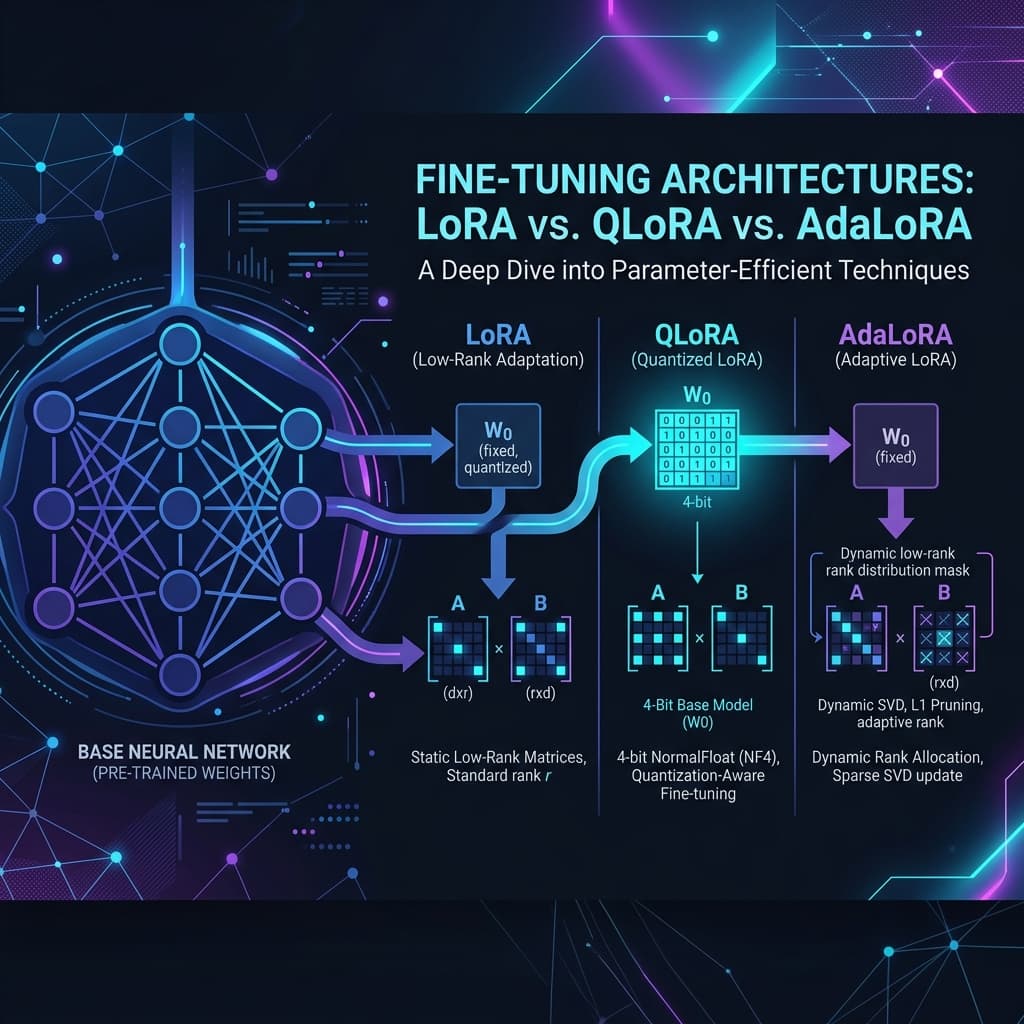
- Low-Rank Adaptation (LoRA): The foundation of modern PEFT. LoRA parameterizes the weight updates of linear layers by decomposing them into two low-rank matrices. This allows the model to learn task-specific adaptations in a lower-dimensional subspace while maintaining the original representation space.
- Quantized LoRA (QLoRA): A memory-optimized evolution of LoRA. QLoRA quantizes the frozen base model weights to an information-theoretically optimal 4-bit representation (NormalFloat4) and computes adapter updates using 16-bit precision. It leverages double quantization and paged optimizers to minimize peak VRAM usage during training.
- Adaptive Low-Rank Adaptation (AdaLoRA): A dynamic variant of LoRA. Rather than applying a fixed rank across all targeted linear layers, AdaLoRA parameterizes the incremental update using a singular value decomposition (SVD) formulation. It dynamically allocates rank budget during training, pruning unimportant singular values and concentrating parameter capacity in critical layers.
Structural Comparison
| Feature | LoRA | QLoRA | AdaLoRA |
|---|---|---|---|
| Base Model Precision | FP16 or BF16 (Unquantized) | 4-bit NormalFloat (NF4) | FP16 or BF16 (Unquantized) |
| Adapter Precision | FP16 or BF16 | FP16 or BF16 | FP16 or BF16 |
| Rank Allocation | Static (Fixed per layer) | Static (Fixed per layer) | Dynamic (Varies per layer) |
| Optimization Target | Compute speed and throughput | VRAM footprint reduction | Parameter efficiency and capacity |
| VRAM Requirement | Moderate | Lowest | Moderate |
| Tooling Ecosystem | Universal (vLLM, TRT-LLM) | Broad (PEFT, Unsloth) | Limited (Often requires conversion) |
Why It Matters
In enterprise environments, the motivation for adopting PEFT is driven by two main factors: hardware economics and operational agility.
The GPU Memory Wall
Training a deep learning model requires storing three major components in GPU memory (VRAM):
- Model Parameters (Weights): The model weights themselves.
- Gradients: The directional derivatives computed during the backward pass.
- Optimizer States: For AdamW, this includes the running average of gradients (first moment) and their squares (second moment).
For a standard 16-bit training run (using FP16 or BF16), the memory overhead is calculated as:
- Weights: 2 bytes per parameter.
- Gradients: 2 bytes per parameter.
- Optimizer States (AdamW): 8 bytes per parameter (4 bytes for the first moment, 4 bytes for the second moment).
- Model States Total: 12 bytes per parameter.
For a 70-billion parameter model (such as Llama 3 70B), storing these model states requires:
Model State VRAM = 70 * 10^9 * 12 bytes = 840 GB
This 840 GB figure excludes the memory required for activations (which store the intermediate layer outputs during the forward pass) and temporary buffers. To perform a full-parameter fine-tuning of Llama 3 70B, an enterprise would need a cluster of at least eight 80GB H100 or A100 GPUs connected via high-bandwidth interconnects (NVLink), introducing significant compute costs and infrastructure complexity.
PEFT reduces this footprint. By freezing the base model, we eliminate the need to compute gradients or store optimizer states for 99% of the parameters. The model states for a frozen 70B base model require only 140 GB (at BF16). If we add a LoRA adapter targeting 0.2% of the parameters (140 million parameters), the training overhead is:
- Base Weights (Frozen): 140 GB.
- Adapter Weights (Trainable): 0.28 GB.
- Adapter Gradients: 0.28 GB.
- Adapter Optimizer States (AdamW): 1.12 GB.
- Total Model States: 141.68 GB.
This reduction allows a 70B parameter model to be fine-tuned on a single node containing two 80GB GPUs instead of requiring an entire cluster.
Multi-Tenant Adapter Serving
From an operational standpoint, deploying customized models for different clients or tasks can quickly lead to high infrastructure costs if each task requires running a separate 70B model instance.
PEFT enables multi-tenant serving. Because the adapter weights are distinct and lightweight (typically between 50 MB and 200 MB), a single base model instance can be kept in GPU memory. At runtime, the server can dynamically load and swap adapter weights based on the incoming request. Specialized serving frameworks, such as LoRAX and S-LoRA, leverage this architecture to serve thousands of distinct fine-tuned adapters on a single GPU node, reducing infrastructure costs.
How It Works
To select and configure these methods, it is helpful to understand the underlying mathematics and mechanics that govern their weight updates.
1. Low-Rank Adaptation (LoRA)
LoRA operates on the principle that the weight updates during adaptation have a low "intrinsic dimension."
Let W_0 represent a pre-trained, frozen weight matrix of a linear layer in the network, where W_0 is of dimension d x k. During fine-tuning, the parameter update Delta W is parameterized by decomposing it into two low-rank matrices B and A:
Delta W = B * A
Where:
Bis a trainable matrix of dimensiond x r.Ais a trainable matrix of dimensionr x k.ris the rank, chosen such thatr << min(d, k).
During the forward pass, the input vector x is multiplied by both the frozen base weights and the trainable adapter matrices:
h = W_0 * x + Delta W * x = W_0 * x + (alpha / r) * B * A * x
Where alpha is a constant scaling hyperparameter. The scaling factor alpha / r is a key component: it stabilizes the training dynamics when experimenting with different values of the rank r. When r is modified, the scaling factor automatically adjusts the magnitude of the adapter's output, preventing the need to re-tune the learning rate.
To ensure that the adapter does not alter the model's behavior at the beginning of training, the matrices are initialized as follows:
Ais initialized using a random Gaussian distribution.Bis initialized to zero.
This initialization ensures that Delta W = 0 at step 0, meaning the training run starts from the exact state of the pre-trained model.
       LoRA Forward Pass Architecture

            Input Vector (x)
             /            \
            /              \
     [Frozen Base]    [Trainable A]
      Weights W_0      (Dimension r x k)
     (Dimension d x k)      |
            |         [Trainable B]
            |         (Dimension d x r)
            |               |
            |         Scaling (alpha / r)
            \              /
             \            /
              [Addition  +]
                    |
              Output Vector (h)
2. Quantized LoRA (QLoRA)
QLoRA, introduced by Dettmers et al. in the seminal QLoRA paper, reduces the memory footprint of LoRA by focusing on the frozen base weights W_0. It introduces three key innovations:
A. 4-bit NormalFloat (NF4) Quantization
Standard quantization methods (like 4-bit integer quantization, or INT4) map values uniformly across a range. However, deep learning model weights typically follow a zero-mean, bell-shaped normal distribution. Mapping these weights to a uniform grid leads to quantization errors for values near the center of the distribution.
NF4 is an information-theoretically optimal quantization scheme for normally distributed data. It defines the quantization bins such that each bin has an equal probability of containing a weight value. This ensures that the information content of the 4-bit representation is maximized, reducing the accuracy loss associated with standard 4-bit quantization.
B. Double Quantization (DQ)
Quantization maps weights to 4-bit indices and stores a scaling constant (quantization constant) for each block of weights to scale them back to their original range. For example, using a block size of 64 parameters, each block requires one 32-bit floating-point scaling constant. This constant adds a memory overhead:
Scaling Constant Overhead = 32 bits / 64 parameters = 0.5 bits per parameter
Double Quantization treats these scaling constants as data to be quantized. It groups the first-stage quantization constants into blocks of 256 and quantizes them to 8-bit FP representation. This second-stage quantization reduces the memory footprint of the constants:
Quantized Scaling Overhead = (32 bits / (64 * 256)) + (8 bits / 64) = 0.0019 + 0.125 = 0.127 bits per parameter
This optimization saves approximately 0.37 bits per parameter, which translates to saving roughly 3 GB of VRAM for a 70B parameter model.
C. Paged Optimizers
During training, activation memory spikes (caused by processing long sequences or large batch sizes) can exceed the GPU's memory limit, triggering an Out-of-Memory (OOM) error. QLoRA introduces Paged Optimizers, which leverage CUDA Unified Memory to page memory between the GPU (VRAM) and the CPU (RAM) during the optimizer update step. When a VRAM allocation spike occurs, the optimizer states for inactive layers are temporarily moved to system RAM, preventing OOM crashes.
During the forward and backward passes, the 4-bit NF4 weights are dequantized to BF16 (or FP16) on-the-fly to perform matrix multiplications. The dequantized weights are stored in temporary SRAM buffers and discarded immediately after the layer computation is complete.
3. Adaptive Low-Rank Adaptation (AdaLoRA)
One limitation of standard LoRA is that it uses a fixed rank r for all targeted layers. In a Transformer model, different layers capture different levels of abstraction. For example, lower layers might focus on syntax and token patterns, while middle and upper layers capture semantic relationships and factual knowledge. Applying the same rank to all layers can result in under-parameterizing critical layers and wasting capacity on less important ones.
AdaLoRA, introduced in the AdaLoRA framework paper, solves this by dynamically allocating the rank budget across targeted layers. To adjust the rank of Delta W during training, AdaLoRA parameterizes the weight update using a Singular Value Decomposition (SVD) formulation:
Delta W = P * Lambda * Q
Where:
Pis a matrix of dimensiond x rcontaining the left singular vectors.Qis a matrix of dimensionr x kcontaining the right singular vectors.Lambdais a diagonal matrix of sizer x rcontaining the singular valueslambda_i.
To prevent SVD from drifting during gradient descent, AdaLoRA adds an orthogonality regularization term to the loss function. This term penalizes deviation from orthogonality:
R(P, Q) = || P^T * P - I ||_F^2 + || Q * Q^T - I ||_F^2
Where:
Iis the Identity matrix.|| . ||_F^2is the squared Frobenius norm.
During training, AdaLoRA maintains a running estimate of the importance of each singular component. The importance score I(lambda_i) is calculated by combining the magnitude of the singular value with the sensitivity of the loss function to that parameter:
I(lambda_i) = s(lambda_i) + (1 / d) * sum(s(p_ij)) + (1 / k) * sum(s(q_ji))
Where s(.) represents the sensitivity metric, computed as the running average of the product of the parameter value and its gradient:
s(theta) = EMA(| theta * (partial L / partial theta) |)
At regular intervals (mask_interval), AdaLoRA evaluates these importance scores across all layers. Singular values (and their corresponding columns in P and rows in Q) that fall below a dynamic threshold are pruned (set to zero). This process shifts parameter capacity from less active layers to those that are critical for the downstream task.
Architecture
To achieve performance comparable to full-parameter fine-tuning, the placement of adapters within the model architecture is a key factor.
Targeted Modules
In early LoRA implementations, adapters were typically applied only to the attention projection matrices: W_q (Query) and W_v (Value). However, empirical studies show that targeting all linear layers in the Transformer architecture yields better downstream performance.
A standard Transformer block contains several linear projection layers:
                                  Transformer Block
                                         |
             +---------------------------+---------------------------+
             |                                                       |
     [Attention Block]                                         [MLP Block]
             |                                                       |
     +-------+-------+                                       +-------+-------+
     |   |   |   |   |                                       |   |   |   |   |
    W_q W_k W_v W_o                                         Gate  Up   Down
                                                            Proj Proj  Proj
- Attention Block:
W_q(Query projection): Maps hidden states to query vectors.W_k(Key projection): Maps hidden states to key vectors.W_v(Value projection): Maps hidden states to value vectors.W_o(Output projection): Projects the concatenated attention outputs back to the hidden dimension.
- MLP (Multi-Layer Perceptron) Block:
Gate Proj(Gate projection): Pre-activation projection in SwiGLU layers.Up Proj(Up projection): Up-samples the hidden state to the intermediate MLP dimension.Down Proj(Down projection): Down-samples the MLP output back to the hidden dimension.
Targeting both the attention block and the MLP block (using a lower rank, such as r=8 or r=16) typically outperforms targeting only the attention block with a higher rank (such as r=64 or r=128). This is because the MLP block holds a significant portion of the model's factual knowledge, and adapting it allows the model to learn new domain-specific representations more effectively.
Production Deployment Considerations
Deploying low-rank adapters in production requires evaluating serving latency and infrastructure constraints.
1. Merging Adapters
If an adapter is served in its raw state, the forward pass must execute two parallel paths: the base weight projection and the low-rank projection. This double computation path adds latency.
To eliminate this latency overhead, you can merge the adapter weights directly into the base model before deployment. Because matrix multiplication is distributive, the merged weights can be computed as:
W_merged = W_0 + (alpha / r) * (B * A)
Once W_merged is computed, the adapter matrices can be discarded. The resulting model has the exact same architecture as the base model, introducing zero latency overhead during inference.
2. The QLoRA Merging Challenge
While merging works well for FP16 and BF16 models, merging adapters into a quantized base model (like 4-bit NF4) introduces a precision mismatch.
If you attempt to merge 16-bit float adapter weights directly into 4-bit quantized base weights, you must first dequantize the base weights to 16-bit, perform the addition, and then re-quantize the model back to 4-bit. This dequantization and re-quantization cycle introduces quantization errors, which can degrade model accuracy.
For high-performance production deployments, the recommended approach is:
- Dequantize the base weights to BF16.
- Merge the adapter weights into the BF16 base model.
- Quantize the merged BF16 model to the target deployment format (such as GPTQ, AWQ, or FP8) using calibration datasets.
3. Multi-Adapter Serving Frameworks
For multi-tenant applications where different users require different fine-tuned adapters, merging is not always practical because it requires running a separate model instance for each user.
In this scenario, serving frameworks like LoRAX or S-LoRA can be used to serve multiple adapters concurrently. These frameworks load the base model once and route incoming requests through the shared base weights. The adapter computations are then performed on-the-fly using specialized kernels (such as SGEMV or multi-size batched GEMM) that process requests with different adapters in a single batch.
Common Mistakes
Enterprise engineers often run into several common pitfalls when training or deploying PEFT models:
- Incorrect Scaling of Alpha Relative to Rank (
r): A common mistake is settingalphaequal torand keeping them locked. If you increase the rankrfrom 8 to 64 but leavealphaequal tor, you change the scale of the gradients and weight updates. The recommended practice is to keepalphaconstant (e.g.,alpha = 32oralpha = 16) while adjustingr. This ensures the learning dynamics remain stable. - Adapting Only Attention Projections:
Fine-tuning only
W_qandW_voften limits the model's capacity to adapt to new styles or vocabulary. For domain customization, configure the run to target all linear layers, including the MLP projection weights. - Mismatching Learning Rates:
PEFT adapters contain fewer parameters than the base model, meaning they typically require a higher learning rate to converge. While full-parameter fine-tuning is usually performed with a learning rate between
1e-5and2e-5, training LoRA adapters typically requires a learning rate between1e-4and2e-4. - Ignoring Weight Tying in PEFT Configuration: Many modern architectures tie the input embeddings and output projection weights to save parameters. When fine-tuning, if the library is not configured to handle tied weights correctly, updating the output projections without adjusting the embeddings can cause training instability. The latest Hugging Face PEFT releases, such as v0.19.1, address this with improved weight-tying checks during initialization.
Lessons From Production Deployments
Operating low-rank adaptation pipelines at scale exposes several system-level issues:
1. Memory Thrashing with Paged Optimizers
While Paged Optimizers prevent OOM crashes by moving optimizer states to CPU RAM, relying on this mechanism can impact training throughput. Moving weights back and forth between GPU VRAM and CPU RAM over the PCIe bus introduces latency:
                                  The Paging Bottleneck

+-----------------------------+   PCIe Bus (16-64 GB/s)   +----------------------------+
|        GPU (VRAM)           |  <=====================>  |         CPU (RAM)          |
|  - Fast Compute (SRAM)      |                           |  - Slow Compute            |
|  - Active Layer Activations |                           |  - Inactive Opt States     |
+-----------------------------+                           +----------------------------+
If the batch size is set too high, the GPU may spend more time waiting for memory pages to transfer than performing tensor computations. This can reduce training speeds by 10x to 100x. Paged Optimizers should be used as a safety fallback, not as a replacement for proper batch size configuration.
2. CUDA Graph Re-recording Spikes
Serving engines like vLLM compile execution paths into CUDA Graphs to minimize CPU launch overhead. However, when using dynamic adapter loading, adding or removing an adapter dynamically can invalidate the compiled graphs, triggering a CUDA graph re-recording. This re-recording process causes sudden latency spikes (often lasting several seconds) for concurrent requests, impacting real-time performance.
3. Evaluation-Phase OOM Crashes
It is common for training runs to execute successfully for hours and then suddenly crash with an OOM error during the evaluation loop. This occurs because the evaluation pass is often configured to use larger batch sizes or process longer validation sequences without freeing intermediate activations, exceeding the GPU's memory limit. To prevent this, ensure that evaluation steps are run under the torch.no_grad() context manager and that the evaluation batch size is configured conservatively.
What Most Articles Miss
Most discussions of PEFT focus on the memory savings of LoRA and QLoRA without addressing their architectural limitations:
The "Rank vs. Content" Tradeoff
LoRA assumes that the change in model behavior can be represented in a low-dimensional subspace. This assumption holds true for style alignment, instruction following, and formatting tasks, where the model is learning how to output information it already knows.
However, if the task requires learning completely new factual information (such as proprietary company terminology or new documentation), low-rank adaptation can struggle. This is because storing new facts requires modifying the core representation space of the model, which cannot always be compressed into low-rank matrices. For tasks that require heavy factual ingestion, full-parameter fine-tuning or continuous pre-training (with small learning rates) remains superior to low-rank adapters.
The True Cost of QLoRA Dequantization
While QLoRA reduces VRAM requirements, it introduces a compute trade-off. Because the base model weights are stored in 4-bit format, they must be dequantized to 16-bit float format during every forward and backward pass before computation can occur. This on-the-fly dequantization adds a compute overhead, typically increasing training times by 20% to 50% compared to standard 16-bit LoRA on the same hardware.
Enterprises must balance the cost of provisioning more GPUs (to run standard LoRA) against the cost of longer training runtimes (when running QLoRA).
Tooling Gaps for AdaLoRA
AdaLoRA offers excellent parameter efficiency, but its adoption in production is limited by a lack of tooling support. Most optimized inference engines (like vLLM or TensorRT-LLM) are designed to serve standard, fixed-rank LoRA adapters. Because AdaLoRA dynamically prunes singular values, the resulting adapter weights have irregular dimensions across different layers. Deploying these adapters typically requires compiling the dynamic weights back into a standard, fixed-rank format, which can negate some of AdaLoRA's efficiency benefits.
Benchmarks
The following benchmarks illustrate the empirical tradeoffs between these techniques:
Table 1: VRAM Memory Allocation Comparison
Based on fine-tuning Llama 3 models with AdamW, batch size of 4, and 4096 context length.
| Model Size | Full Fine-Tuning | LoRA (r=16, BF16) | QLoRA (r=16, NF4) | AdaLoRA (r=16, BF16) |
|---|---|---|---|---|
| 8B (Llama 3) | 160 GB (2x A100 80G) | 26 GB (1x A100 80G) | 9 GB (1x RTX 4090 24G) | 27 GB (1x A100 80G) |
| 70B (Llama 3) | 1400 GB (16x A100 80G) | 185 GB (4x A100 80G) | 48 GB (1x A100 80G) | 190 GB (4x A100 80G) |
| 405B (Llama 3) | 8100 GB (128x H100 80G) | 980 GB (16x H100 80G) | 270 GB (4x H100 80G) | 1020 GB (16x H100 80G) |
Table 2: Training Speed & Throughput
Based on training an 8B model on a single H100 GPU (80GB VRAM) using FP8/BF16 mixed precision.
| Method | Tokens/sec/GPU | Relative Training Time | Max Batch Size (No OOM) | Paged Optimizer Active |
|---|---|---|---|---|
| Full Fine-Tuning | 1250 | 1.0x (Baseline) | 8 | No |
| LoRA (r=16) | 3850 | 0.32x | 32 | No |
| QLoRA (r=16) | 2750 | 0.45x | 64 | Optional |
| AdaLoRA (r=16) | 3150 | 0.40x | 28 | No |
Table 3: Downstream Task Performance (Accuracy %)
Evaluated on Llama 3 8B after fine-tuning on a domain-specific dataset (medical QA and coding instructions).
| Task | Pre-trained Base | Full Fine-Tuning | LoRA (r=16, FFN+Attn) | QLoRA (r=16, FFN+Attn) | AdaLoRA (Avg r=16) |
|---|---|---|---|---|---|
| MMLU (Medical) | 66.4% | 72.8% | 72.2% | 71.5% | 72.6% |
| GSM8K (Math) | 78.2% | 84.5% | 83.9% | 83.1% | 84.2% |
| HumanEval (Coding) | 62.2% | 69.4% | 68.8% | 68.0% | 69.1% |
Best Practices
To optimize PEFT pipelines for enterprise workloads, consider the following implementation checklist:
1. Hardware Provisioning
- If VRAM is constrained and compute budgets are tight, default to QLoRA. It allows you to train larger models on smaller GPU footprints.
- If training throughput and speed are your primary constraints, use LoRA with unquantized BF16 base weights.
- Avoid using Paged Optimizers as a primary scaling mechanism; size your batches so that training fits within native VRAM limits.
2. Hyperparameter Settings
- Rank (r): Start with
r = 16. For highly complex or multilingual datasets, scale up tor = 32orr = 64. - Alpha (alpha): Lock
alphaat double the rank value (e.g.,alpha = 32forr = 16). This maintains stable gradient scaling. - Target Modules: Target all linear layers (
q_proj,k_proj,v_proj,o_proj,gate_proj,up_proj,down_proj) rather than just the attention weights.
3. Evaluation and Deployment
- Monitor training and validation loss curves. If the validation loss starts to diverge early, reduce the learning rate or decrease the rank.
- Before deploying, perform validation evaluations on the merged model weights to verify that the merging process has not introduced precision degradation.
- For multi-tenant applications, use serving engines like LoRAX or S-LoRA to serve adapters dynamically without running separate model instances.
FAQ
1. What is the difference between LoRA and QLoRA?
LoRA applies low-rank trainable adapter matrices to an unquantized (16-bit) base model. QLoRA extends this by quantizing the base model weights to 4-bit NormalFloat (NF4) format, reducing VRAM consumption by up to 75% while maintaining comparable accuracy.
2. Does LoRA add latency during inference?
In its raw state, yes, because the model must process inputs through both the base weights and the adapter matrices. However, you can merge the adapter weights directly into the base weights prior to deployment, which eliminates this latency overhead.
3. Can I merge multiple LoRA adapters into a single base model?
Yes. Since matrix addition is commutative, you can merge multiple adapters into a single base model. However, merging conflicting adapters (trained on different tasks) can lead to representation interference and degrade model performance.
4. What is the recommended learning rate for LoRA fine-tuning?
LoRA adapters typically require a learning rate between 1e-4 and 2e-4. This is higher than the learning rates used for full-parameter fine-tuning (typically 1e-5 to 2e-5).
5. What is the role of alpha in LoRA configuration?
The alpha parameter is a scaling factor that adjusts the magnitude of the adapter's output. Keeping alpha constant while adjusting the rank r stabilizes the weight updates, preventing the need to re-tune the learning rate.
6. How does AdaLoRA differ from standard LoRA?
Standard LoRA applies a fixed rank r to all targeted layers. AdaLoRA decomposes the weight update using SVD and dynamically allocates the rank budget, pruning less important weights and concentrating parameter capacity in critical layers.
7. Why does merging QLoRA adapters into quantized weights cause performance drops?
Merging 16-bit float adapter weights directly into a 4-bit quantized base model requires dequantizing the base model to 16-bit, performing the addition, and then re-quantizing it back to 4-bit. This cycle introduces quantization errors that can degrade model accuracy.
8. What is Double Quantization in QLoRA?
Double Quantization quantizes the first-stage quantization constants (scaling factors) of the 4-bit base weights to 8-bit float representation. This optimization saves approximately 0.37 bits per parameter, reducing the VRAM footprint by several gigabytes.
9. How do Paged Optimizers prevent OOM errors?
Paged Optimizers leverage CUDA Unified Memory to page memory between the GPU and the CPU. During peak VRAM spikes, inactive optimizer states are moved to system RAM, preventing Out-of-Memory crashes.
10. Can I use LoRA for factual knowledge ingestion?
LoRA is highly effective for style alignment, instruction following, and formatting tasks. However, for tasks that require the model to learn completely new factual information, full-parameter fine-tuning or continuous pre-training remains superior.
Key Takeaways
- PEFT reduces training VRAM requirements: By freezing the base model, PEFT eliminates the need to store gradients and optimizer states for 99% of parameters, allowing larger models to be trained on smaller hardware footprints.
- Targeting all linear layers is critical: For optimal downstream accuracy, target all linear layers (both attention and MLP blocks) with your adapter matrices.
- Lock your alpha scaling parameter: Keep the
alphahyperparameter constant when experimenting with different rankrvalues to stabilize training dynamics and avoid re-tuning learning rates. - Merge adapters for low-latency inference: Prior to deployment, merge the adapter weights back into the base model to eliminate the computational overhead of running parallel projection paths.
- Avoid merging directly into quantized base weights: To prevent accuracy loss from quantization errors, dequantize the base model to BF16, merge the adapter, and then quantize the merged model to your target format.
- Evaluate the dequantization cost of QLoRA: QLoRA saves VRAM but introduces an on-the-fly dequantization overhead that can increase training runtimes by 20% to 50% compared to standard LoRA.