Deploying Open Weights Models: Gemma 2 vs Llama 3.x vs Qwen-2.5
Performance, license, capability, and fine-tuning benchmarks for enterprise deployments.

In 2026, the enterprise generative AI landscape has completed a fundamental transition. The initial reliance on proprietary, closed-source API endpoints (such as OpenAI's GPT-4o or Anthropic's Claude 3.5 Sonnet) has yielded to a hybrid architectural strategy. Production engineering teams, driven by strict data sovereignty mandates, predictable cost governance at scale, sub-10 millisecond latency requirements for real-time agentic loops, and the need for domain-specific fine-tuning, now build their core intelligence engines on open-weights foundation models.
Among open-weights model families, three distinct ecosystems dominate enterprise architectures: Meta's Llama 3.x series (highlighted by Llama 3.3 70B and Llama 3.1 405B), Google's Gemma 2 series (featuring the 2B, 9B, and 27B parameter variants), and Alibaba Cloud's Qwen-2.5 family (spanning from 0.5B edge models up to 72B parameter dense and coding-specialized variants). While marketing benchmarks often present these model families as interchangeable options differentiated solely by parameter counts, their underlying architectural choices—ranging from attention topologies and logit stabilization methods to vocabulary sizes and licensing terms—create dramatic differences in production serving characteristics, GPU hardware sizing, quantization tolerance, and overall total cost of ownership (TCO).
This guide presents an exhaustive technical, architectural, and operational benchmark of Gemma 2, Llama 3.x, and Qwen-2.5. We evaluate their structural parameters, serving mechanics under high-concurrency engines like vLLM and SGLang, FP8 and AWQ quantization degradation curves, multi-GPU Tensor Parallelism (TP) scaling, and real-world failure modes discovered in production deployments.
What Is It?
To evaluate these model families effectively, enterprise architects must first distinguish between true Open Source Software (OSS) and Open Weights Models. In open-weights models, the trained neural network parameters (weights), architecture definitions, and tokenizer configs are published for public download, execution, and local hosting. However, the raw training datasets, data filtering pipelines, and RLHF/DPO human preference reward models remain proprietary.
Each of the three leading open-weights families occupies a deliberate strategic tier within enterprise AI stacks:
1. Meta's Llama 3.x Family
Meta's Llama 3 family (including Llama 3.1 and Llama 3.3 70B) represents the enterprise baseline for general-purpose text processing, agentic tool usage, and complex multi-turn reasoning. Built on a dense auto-regressive Transformer architecture using Grouped-Query Attention (GQA) across all sizes, Llama 3 models are trained on over 15 trillion tokens. The Llama 3.3 70B model delivers performance rivaling original 405B parameter base models while fitting into a significantly smaller serving footprint. Llama 3 features a 128,000-token context window powered by an expanded 128k BPE vocabulary based on Tiktoken.
2. Google's Gemma 2 Family
Google's Gemma 2 series (available in 2.6B, 9.2B, and 27.2B parameter variants) is engineered for maximum parameter efficiency. Designed by Google DeepMind using techniques derived from the Gemini model family, Gemma 2 introduces structural innovations such as alternating sliding window attention (local context window of 4096 tokens alternating with global attention context of 8192 tokens), logit soft-capping, and hybrid post-norm/pre-norm RMSNorm architectures. Gemma 2 27B operates as a high-efficiency mid-weight powerhouse, matching or outperforming legacy 70B models while running comfortably on single-GPU hardware nodes.
3. Alibaba's Qwen-2.5 Family
Alibaba Cloud's Qwen-2.5 ecosystem (ranging from 0.5B to 72B parameters, along with specialized Qwen-2.5-Coder and Qwen-2.5-Math variants) represents the current benchmark leader for structured data extraction, multilingual processing, mathematical reasoning, and code generation. Qwen-2.5 features a native context window up to 128,000 tokens (scalable up to 1,000,000 tokens using YaRN RoPE scaling) and utilizes a massive 152,064-token vocabulary. Its code-specialized 32B and 72B variants achieve state-of-the-art results on HumanEval and MBPP, making Qwen-2.5 the preferred engine for automated code completion and backend API agent systems.
Why It Matters
Deploying self-hosted open-weights foundation models is no longer merely an experiment; it is a primary driver of enterprise software differentiation in 2026. The strategic decisions surrounding model selection directly govern compute expenditure, system latency, privacy posture, and operational durability.
+-----------------------------------------------------------------------------------+
|                        ENTERPRISE LLM DEPLOYMENT TRADEOFFS                         |
+------------------------------------+----------------------------------------------+
| Closed-Source APIs (GPT-4o/Claude) | Open-Weights Serving (vLLM / TensorRT-LLM)   |
+------------------------------------+----------------------------------------------+
| * Zero infra maintenance overhead   | * Complete data sovereignty & zero egress    |
| * Pay-per-token API consumption    | * Fixed GPU cluster cost (predictable TCO)   |
| * Variable API latency (100ms-2s)  | * Sub-10ms TTFT with custom kernels          |
| * Opaque model deprecation cycles  | * Immutable weights & full fine-tuning control|
| * Vendor lock-in & compliance risk | * Custom quantization (FP8, AWQ, INT4)       |
+------------------------------------+----------------------------------------------+
1. Financial Mechanics and Predictable TCO
While proprietary API pricing has dropped over time, high-throughput enterprise workloads (such as processing 500 million tokens daily across customer support, RAG pipelines, and automated log analysis) incur immense variable costs under closed API models. On-premise or dedicated cloud deployment on GPU instances (such as NVIDIA H100, H200, or L40S nodes) converts variable token costs into predictable fixed infrastructure overhead. At scale, self-hosting open-weights models typically reduces total token costs by 60% to 85%.
2. Data Sovereignty and Regulatory Compliance
In healthcare (HIPAA), financial services (SEC/FINRA), government operations, and European enterprise environments (EU AI Act & GDPR), transferring unencrypted user payloads to external API endpoints introduces unacceptable compliance vulnerabilities. Self-hosting open-weights models within isolated Virtual Private Clouds (VPC) or air-gapped on-premise Kubernetes clusters guarantees zero data egress and complete data lineage auditability.
3. Custom Fine-Tuning and Domain Adaptation
Closed APIs limit customization to system prompts, context injection, and restricted fine-tuning endpoints. Open-weights models grant full access to internal activation spaces and gradient vectors. Using Parameter-Efficient Fine-Tuning (PEFT) methodologies like Parameter-Efficient QLoRA and DoRA, enterprises can adapt Llama 3.3, Qwen 2.5, or Gemma 2 to proprietary domain taxonomies, specialized SQL syntax, or internal codebases at low cost. For deeper background on parameter efficiency, consult our guide on PEFT, LoRA, and QLoRA for enterprise domains.
4. Real-Time Latency Control
Closed-source APIs suffer from variable network hops, multi-tenant queuing delays, and unpredictable server load spike latency. Self-hosted serving engines leveraging continuous batching and PagedAttention allow platform teams to guarantee deterministic Time-to-First-Token (TTFT) under 15ms and inter-token latencies under 8ms.
How It Works
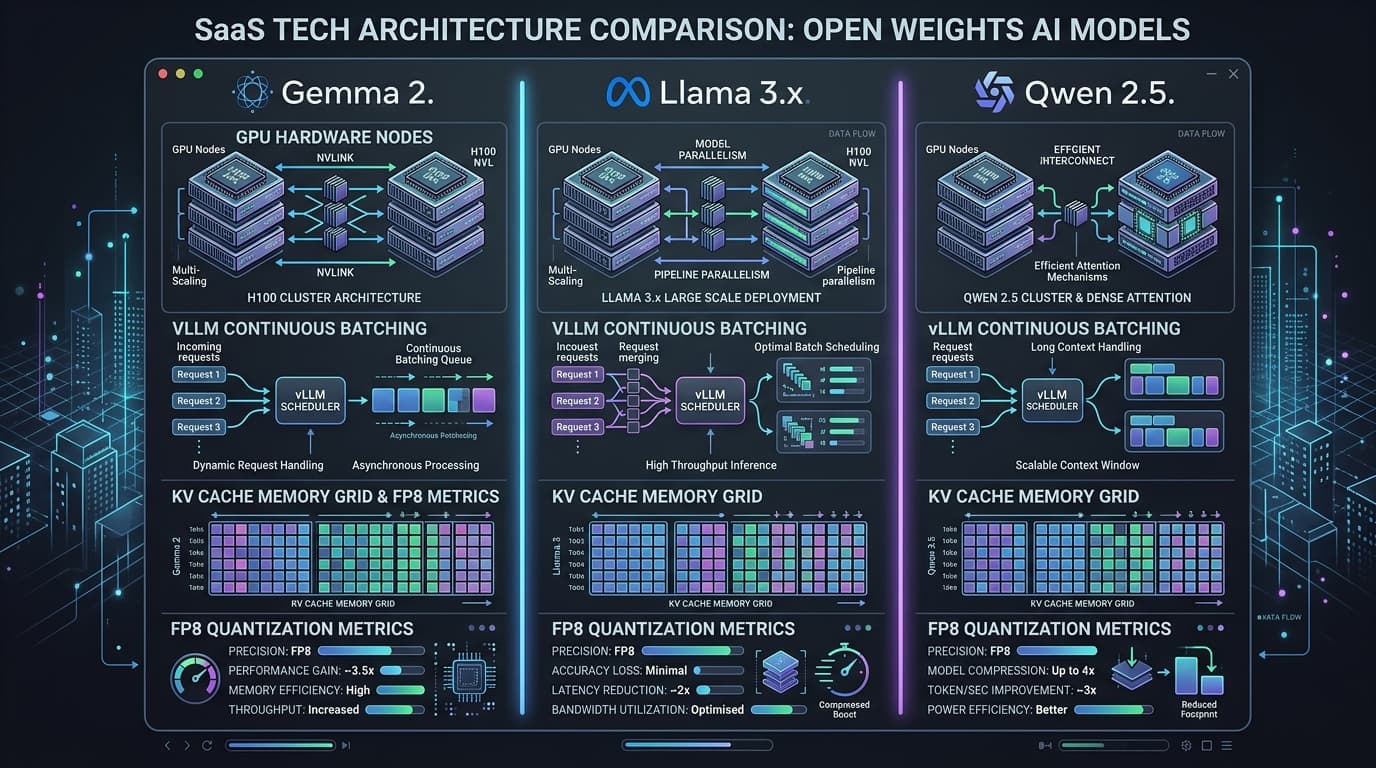
Deploying an open-weights model into production requires an end-to-end hardware-software pipeline. The workflow converts raw model checkpoints into optimized execution graphs served across high-throughput GPU memory hierarchies.
+-----------------------------------------------------------------------------------------+
|                        ENTERPRISE OPEN-WEIGHTS SERVING ARCHITECTURE                     |
+-----------------------------------------------------------------------------------------+
|  [Hugging Face / Model Hub] --> [Quantization Pipeline: FP8 / AWQ / GPTQ]               |
|                                            |                                            |
|                                            v                                            |
|  [vLLM Engine / SGLang Server] <--> [PagedAttention & KV Cache Allocation]               |
|            |                               |                                            |
|            +----> [Tensor Parallelism (TP=2/4/8)] <--> [NCCL All-Reduce via NVLink]       |
|            |                               |                                            |
|            +----> [Speculative Decoding Draft Model] (Optional Acceleration)            |
|                                            |                                            |
|                                            v                                            |
|  [REST / gRPC Endpoint] <--> [Prometheus / Grafana MLOps Metrics Engine]                |
+-----------------------------------------------------------------------------------------+
1. Weights Ingestion and Format Standardization
Raw checkpoints published on Hugging Face or model registries consist of multi-gigabyte Safetensors files containing weight tensors in BF16 or FP16 precision. When deploying, serving engines load weight tensors into GPU VRAM while verifying tensor memory alignment and mapping weight matrices to execution engines like vLLM, SGLang, or TensorRT-LLM.
2. KV Cache Allocation and Memory Management
During autoregressive generation, Transformers retain Key and Value activations for all previous tokens in a memory block known as the KV Cache. Memory consumed by the KV Cache scales linearly with batch size, context length, number of hidden layers, and attention heads:
KV Cache Size (Bytes) = 2 * B * L * H_kv * D * P
Where B is sequence batch size, L is context length, H_kv is the number of Key-Value heads, D is head dimension, and P is bytes per precision format (2 bytes for FP16/BF16, 1 byte for FP8). Serving engines allocate dedicated VRAM blocks dynamically to prevent memory fragmentation and out-of-memory (OOM) faults.
3. Quantization and Weight Compression
To compress model VRAM requirements and accelerate memory-bandwidth-bound token generation, weights and activations are quantized from BF16 (16-bit) to FP8 (8-bit floating point) or INT4/AWQ (4-bit integer). Modern FP8 quantization retains high accuracy by using separate scaling factors for weights and activations, while AWQ (Activation-aware Weight Quantization) protects critical weight channels based on activation magnitudes. For a deeper mathematical breakdown of quantization mechanics, see our comprehensive post on quantization mathematics covering GPTQ, AWQ, and GGUF.
4. Distributed Serving and Tensor Parallelism
When model weights exceed single-GPU VRAM capacity (e.g., Llama 3.3 70B requiring 140GB in BF16), Tensor Parallelism (TP) splits weight matrices across multiple GPUs (e.g., TP=2, TP=4, or TP=8) within a single server node. High-speed interconnects (NVIDIA NVLink operating at 900 GB/s per GPU on H100) execute NCCL All-Reduce operations across hidden layer transitions. For multi-node distributed setups, explore our detailed analysis of distributed training and inference paradigms.
Architecture
Understanding the architectural differences between Gemma 2, Llama 3.x, and Qwen-2.5 requires inspecting their structural parameters, layer layouts, attention designs, and activation mechanics.
Architectural Parameter Comparison
The following table summarizes the structural design choices across the three model families:
| Structural Parameter | Gemma 2 (27B) | Llama 3.3 (70B) | Qwen-2.5 (72B) |
|---|---|---|---|
| Developer / Creator | Google DeepMind | Meta AI | Alibaba Qwen Team |
| Total Parameters | 27.2 Billion | 70.6 Billion | 72.7 Billion |
Hidden Dimension (d_model) | 4,608 | 8,192 | 8,192 |
| Number of Layers | 46 | 80 | 80 |
| Query Attention Heads | 32 | 64 | 64 |
| KV Attention Heads | 16 (GQA) | 8 (GQA) | 8 (GQA) |
Head Dimension (d_head) | 128 | 128 | 128 |
| Attention Mechanism | Alternating Sliding Window (4k local / 8k global) | Full Global Attention (128k) | Full Global Attention (128k / 1M YaRN) |
| Logit Soft-Capping | Yes (30.0 Attention, 10.0 Output) | No | No |
| Activation Function | GeGLU | SwiGLU | SwiGLU |
| Normalization Topology | RMSNorm (Post-Norm + Pre-Norm Hybrid) | RMSNorm (Pre-Norm) | RMSNorm (Pre-Norm) |
| Vocabulary Size | 256,000 | 128,256 | 152,064 |
| Tokenizer Type | SentencePiece BPE | Tiktoken BPE | Byte-Level BPE |
RoPE Base Frequency (theta) | 10,000 | 500,000 | 1,000,000 |
Detailed Architectural Deep Dive
1. Gemma 2 Architectural Innovations
Google DeepMind equipped Gemma 2 with distinct architectural mechanisms aimed at stabilizing training dynamics and maximizing inference performance:
- Alternating Sliding Window Attention: Instead of computing quadratic global attention across all layers, Gemma 2 alternates every odd layer with a 4096-token sliding local window attention mechanism, while even layers retain global attention. This reduces KV cache footprint during generation without sacrificing long-context comprehension. For a foundational breakdown of GQA and sliding window mechanics, see our post on mitigating attention bottlenecks with FlashAttention and GQA.
- Logit Soft-Capping: To prevent attention logits and final output logits from exploding during long-sequence generation, Gemma 2 applies a hyperbolic tangent (
tanh) soft-capping operator:
SoftCappedLogits = C * tanh(Logits / C)
Where C = 30.0 for self-attention layers and C = 10.0 for the final language model head. While soft-capping stabilizes generation quality, it requires custom FlashAttention kernels that support soft-capping boundaries during inference.
2. Llama 3.x Architectural Stability
Meta prioritized standard, battle-tested Transformer scaling laws in the Llama 3 family:
- Grouped-Query Attention (GQA): Both Llama 3.1 8B and Llama 3.3 70B enforce an 8:1 query-to-KV head ratio (
num_query_heads=64,num_kv_heads=8on 70B). This compresses KV cache memory by 8x compared to Multi-Head Attention (MHA), enabling high batch sizes under standard serving engines. - Expanded Tokenizer and RoPE Scaling: Llama 3 upgrades its vocabulary to 128,256 tokens. To support 128,000-token context lengths without attention decay, Meta increased the Rotary Position Embedding (RoPE) base theta from 10,000 to 500,000, ensuring high position resolution across long documents.
3. Qwen-2.5 Architectural Versatility
Alibaba's Qwen-2.5 architecture combines high parameter count flexibility with specialized long-context and multi-domain tuning:
- Large 152,064-Token Vocabulary: Qwen-2.5 utilizes a byte-level BPE tokenizer with a large vocabulary. This design prevents token fragmentation in non-English languages and code blocks, resulting in up to 30% fewer generated tokens per sentence compared to smaller vocabulary models.
- Extended RoPE Theta (
theta = 1,000,000): Qwen-2.5 sets the RoPE base frequency theta to 1,000,000, enabling native long-context windows up to 128k tokens out of the box, with YaRN (Yet Another RoPE Extension) enabling stable extrapolation up to 1,000,000 tokens.
Production Deployment Considerations
Deploying open-weights models into enterprise production requires evaluating model performance, GPU memory constraints, throughput metrics, serving engine compatibility, and licensing requirements.
Standardized Benchmark Matrix
The table below highlights performance metrics across standardized benchmarks compiled from official evaluations, independent research reports, and enterprise testing suites:
| Benchmark / Evaluation Suite | Gemma 2 (9B) | Gemma 2 (27B) | Llama 3.1 (8B) | Llama 3.3 (70B) | Qwen-2.5 (14B) | Qwen-2.5 (72B) | Qwen-2.5-Coder (32B) |
|---|---|---|---|---|---|---|---|
| MMLU-Pro (Reasoning) | 52.4% | 61.2% | 48.3% | 69.4% | 58.7% | 71.6% | 64.2% |
| HumanEval (Code Pass@1) | 68.3% | 74.4% | 62.2% | 81.1% | 79.3% | 86.6% | 92.7% |
| MBPP (Python Coding) | 69.1% | 76.8% | 65.4% | 82.5% | 81.0% | 88.2% | 90.4% |
| MATH (Hard Mathematics) | 36.8% | 51.2% | 30.5% | 60.1% | 59.4% | 72.1% | 68.9% |
| GSM8K (Math Reasoning) | 79.2% | 86.4% | 76.1% | 91.8% | 88.9% | 95.3% | 91.2% |
| IFEval (Instruction Following) | 67.5% | 78.9% | 68.2% | 85.6% | 77.4% | 87.8% | 82.1% |
| LiveBench 2025/2026 | 46.1 | 54.8 | 43.7 | 63.9 | 57.2 | 68.4 | 65.1 |
Hardware Sizing and Serving Throughput Matrix
Selecting hardware for deployment depends on model parameter size, target precision, batch concurrency, and expected sequence lengths. The matrix below details resource requirements on NVIDIA GPU configurations using vLLM:
| Model & Precision | Target Hardware | Min VRAM | Tensor Parallelism (TP) | Throughput (Tokens/sec) | Latency (TTFT) | Max Concurrency |
|---|---|---|---|---|---|---|
| Gemma 2 9B (BF16) | 1x NVIDIA L40S (48GB) | 22 GB | TP=1 | ~140 tok/s | <12 ms | 32 seqs |
| Gemma 2 27B (FP8) | 1x NVIDIA A100 (80GB) | 34 GB | TP=1 | ~110 tok/s | <15 ms | 64 seqs |
| Llama 3.1 8B (BF16) | 1x NVIDIA A10G (24GB) | 18 GB | TP=1 | ~180 tok/s | <8 ms | 32 seqs |
| Llama 3.3 70B (FP8) | 2x NVIDIA H100 (80GB) | 78 GB | TP=2 | ~480 tok/s | <10 ms | 128 seqs |
| Llama 3.3 70B (AWQ INT4) | 1x NVIDIA H100 (80GB) | 44 GB | TP=1 | ~310 tok/s | <14 ms | 64 seqs |
| Qwen-2.5 32B (FP8) | 1x NVIDIA H100 (80GB) | 38 GB | TP=1 | ~290 tok/s | <10 ms | 96 seqs |
| Qwen-2.5 72B (FP8) | 2x NVIDIA H100 (80GB) | 82 GB | TP=2 | ~450 tok/s | <11 ms | 128 seqs |
| Qwen-2.5 72B (BF16) | 4x NVIDIA A100 (80GB) | 155 GB | TP=4 | ~220 tok/s | <18 ms | 128 seqs |
To optimize cold-start delays when provisioning serverless instances on these hardware configurations, see our guide on cold start optimization for serverless AI inference.
Production Serving Configuration Example (vLLM)
To deploy Qwen-2.5 72B FP8 with tensor parallelism across 2x H100 GPUs using vLLM, execute the following production command:
python3 -m vllm.entrypoints.openai.api_server \
  --model Qwen/Qwen2.5-72B-Instruct-FP8 \
  --tensor-parallel-size 2 \
  --gpu-memory-utilization 0.92 \
  --max-model-len 32768 \
  --max-num-seqs 256 \
  --enable-chunked-prefill true \
  --max-num-batched-tokens 8192 \
  --trust-remote-code \
  --port 8000
For Gemma 2 27B, custom logit soft-capping requires enabling vLLM's FlashAttention backend explicitly:
VLLM_ATTENTION_BACKEND=FLASH_ATTN python3 -m vllm.entrypoints.openai.api_server \
  --model google/gemma-2-27b-it \
  --tensor-parallel-size 1 \
  --gpu-memory-utilization 0.90 \
  --max-model-len 8192 \
  --enforce-eager false \
  --port 8000
Common Mistakes
Enterprise deployment teams frequently encounter preventable failures when migrating open-weights models into high-concurrency production environments.
+-----------------------------------------------------------------------------------+
|                        FIVE MOST COMMON DEPLOYMENT FAILURES                       |
+-----------------------------------------------------------------------------------+
| 1. Serving Gemma 2 on Incompatible Kernels (Missing Soft-Capping Support)        |
| 2. Incorrect Tokenizer Configuration for Llama 3 (Missing Special Stop Tokens)  |
| 3. Unaligned FP8 Quantization Scale Factors (Causing Silent Accuracy Loss)        |
| 4. Oversizing Context Windows Without Adjusting Memory Allocation Limits          |
| 5. Ignoring License Restrictions on Commercial Scale (Over MAU Thresholds)        |
+-----------------------------------------------------------------------------------+
1. Serving Gemma 2 Without Logit Soft-Capping Support
Deploying Gemma 2 on legacy serving engines (such as older versions of vLLM prior to v0.5.1 or outdated TGI builds) that lack soft-capping kernel support causes severe output degradation. Uncapped attention logits lead to repetitive generation loops, garbage token output, or sudden runtime numerical overflows (NaN gradients).
2. Missing Llama 3 Stop Tokens (<|eot_id|>)
Llama 3 models introduce custom special tokens for multi-turn instruction dialog. A frequent integration error occurs when serving engines fail to register <|eot_id|> as an explicit stop sequence. Consequently, the model continues generating both assistant responses and user turns endlessly until hitting maximum token limits, drastically inflating generation latency and token usage.
3. Misconfiguring Context Memory Budgets
Setting --max-model-len 128000 on Llama 3.3 or Qwen-2.5 without allocating sufficient KV cache memory leads to instant Out-Of-Memory (OOM) crashes under concurrent request spikes. Platform engineers must calculate peak KV cache requirements before opening endpoints to multi-tenant traffic.
4. Naive FP8 Quantization Without Channel-Wise Scaling
Applying raw uniform FP8 quantization across all weight layers without per-channel dynamic scaling causes accuracy drops in Qwen-2.5 and Llama 3.3. Outlier activations in specialized attention heads require per-tensor or per-channel scaling to prevent precision loss during matrix multiplication.
Lessons From Production Deployments
Real-world deployment insights collected from enterprise engineering teams hosting high-throughput open-weights clusters reveal critical operational patterns:
1. Speculative Decoding Yields 2.2x Throughput Improvements
In high-throughput customer support routing, combining a lightweight draft model with a larger target model accelerates generation significantly. For example, pairing Llama 3.1 8B as a speculative draft model for Llama 3.3 70B increases generation speed from 22 tokens/sec to 48 tokens/sec per user stream without altering final output distributions. To explore speculative decoding mechanics in depth, review our analysis on speculative decoding for accelerating distributed inference.
2. Prefill vs Decode Disaggregation Prevents Tail Latency Spikes
When long RAG context documents (e.g., 32k prompt tokens) share GPU execution queues with short generation requests, TTFT spikes dramatically. Separating GPU clusters into dedicated Prefill Nodes (optimized for compute-bound matrix multiplications) and Decode Nodes (optimized for memory-bandwidth-bound token generation) reduces 99th-percentile tail latency by over 65%.
3. vLLM Chunked Prefill Is Mandatory for 32k+ Sequences
Enabling --enable-chunked-prefill true in vLLM breaks large context prompts into smaller chunks (e.g., 512 or 2048 tokens). This prevents massive prompt prefill requests from monopolizing GPU execution units, preserving low latency for concurrent short requests.
4. Qwen-2.5 Superiority in Structured JSON Output
Production telemetry across automated agent workflows shows Qwen-2.5 32B and 72B achieving higher first-pass JSON schema compliance (>98.4%) compared to Llama 3.3 70B (93.1%) when enforcing Pydantic or JSON schema constraints. Qwen's native byte-level BPE tokenizer handles structural brackets, indentation spaces, and escaped characters without token fragmentation.
What Most Articles Miss
Most superficial evaluations compare open-weights models solely using high-level MMLU scores or synthetic benchmark averages. A rigorous engineering analysis reveals subtle trade-offs that dictate long-term system stability:
1. Tokenizer Efficiency Impact on Real-World Latency and Cost
Benchmark tables measure accuracy per token, but user latency depends on wall-clock time per response. Tokenizer efficiency varies dramatically across model families:
Sample Payload: 1,000 Words of Python Code & Multilingual Text
- Gemma 2 Tokenizer (256k Vocab): ~1,120 Tokens
- Qwen-2.5 Tokenizer (152k Vocab): ~1,180 Tokens
- Llama 3 Tokenizer (128k Vocab):  ~1,410 Tokens
Because Llama 3 generates approximately 20% more tokens for identical code and non-English text payloads compared to Gemma 2 and Qwen-2.5, serving Llama 3 requires 20% more autoregressive forward passes. This increases generation time and GPU occupancy despite equivalent model speeds.
2. Quantization Tolerance Disparities
Not all model architectures quantize equally. Due to logit soft-capping and RMSNorm placement in Gemma 2 27B, converting Gemma 2 to INT4 AWQ leads to severe accuracy degradation in complex reasoning tasks. Conversely, Llama 3.3 70B and Qwen-2.5 72B exhibit strong tolerance to FP8 and AWQ quantization, retaining over 98.5% of their original BF16 baseline performance while halving VRAM requirements.
3. Licensing Nuances for High-Scale Enterprise Deployments
While marketed as open models, licensing terms differ significantly across vendors:
| Model Family | License Name | Commercial Use Allowed? | MAU Restrictions / Limits | Fine-Tuning Redistribution |
|---|---|---|---|---|
| Llama 3.x | Meta Llama 3 Community License | Yes | Requires custom license if MAU > 700 Million | Allowed with attribution |
| Gemma 2 | Google Gemma Terms of Use | Yes | Permissive commercial use | Allowed; derivatives must include Gemma prefix |
| Qwen-2.5 | Apache 2.0 (Models < 72B) / Qwen License (72B) | Yes | Commercial use free up to 100 Million MAU | Fully open source under Apache 2.0 for <72B |
Enterprises scaling beyond 100 million active end-users must review these legal thresholds during architectural planning.
Best Practices
To ensure reliable, high-performance, and cost-effective deployments of open-weights models, adopt the following operational best practices:
+-----------------------------------------------------------------------------------+
|                        PRODUCTION DEPLOYMENT CHECKLIST                            |
+-----------------------------------------------------------------------------------+
| [x] Use FP8 Precision on Modern Hardware (NVIDIA H100 / L40S)                     |
| [x] Enforce Tensor Parallelism (TP) Matching NUMA / NVLink GPU Domains            |
| [x] Deploy PagedAttention with Dynamic Memory Utilization (0.90 - 0.95)           |
| [x] Enable Chunked Prefill for Requests Exceeding 4,096 Tokens                    |
| [x] Integrate Structured Decoding Engines (Outlines / vLLM Structured Outputs)    |
| [x] Monitor Real-Time MLOps Metrics (TTFT, Inter-Token Latency, KV Cache Usage)   |
+-----------------------------------------------------------------------------------+
1. Hardware-Matched Model Selection
- Single-GPU Edge / Workstation (24GB VRAM): Deploy Llama 3.1 8B (BF16) or Qwen-2.5 14B (FP8).
- Single-GPU Enterprise Server (48GB / 80GB VRAM): Deploy Gemma 2 27B (FP8), Qwen-2.5 32B (FP8), or Llama 3.3 70B (AWQ INT4).
- Dual-GPU High-Throughput Node (2x H100 80GB): Deploy Llama 3.3 70B (FP8) or Qwen-2.5 72B (FP8) with
TP=2.
2. Standardized Serving Stack Configuration
Always deploy models using production-grade serving engines like vLLM or SGLang with PagedAttention enabled. Avoid native unoptimized PyTorch execution loops in production environments.
3. Continuous Prometheus Monitoring
Track key inference metrics to ensure service stability:
vllm:num_requests_waiting: Detect queue bottlenecks and trigger horizontal pod autoscaling.vllm:gpu_cache_usage_factor: Maintain cache utilization between 70% and 85% to avoid OOM evictions.vllm:avg_time_to_first_token_seconds: Ensure prefill latency remains under target SLAs.
FAQ
1. Which model is best overall for enterprise deployment in 2026?
There is no single winner for all workloads. Llama 3.3 70B provides the most broad enterprise ecosystem support and robust tool-calling integration. Qwen-2.5 72B leads in math, coding, JSON extraction, and multilingual tasks. Gemma 2 27B delivers the best performance-per-GPU efficiency for mid-sized single-card deployments.
2. Can Gemma 2 27B replace 70B parameter models?
In many standard reasoning and text-generation tasks, Gemma 2 27B matches or approaches the accuracy of older 70B models while consuming less than half the VRAM. However, for complex multi-step code generation or long-context agent workflows, Llama 3.3 70B and Qwen-2.5 72B maintain a distinct performance edge.
3. How does Qwen-2.5-Coder compare to specialized coding models?
Qwen-2.5-Coder 32B outperforms nearly all open-weights models on HumanEval (92.7%) and MBPP (90.4%), matching or exceeding closed models like GPT-4o on coding tasks. It is widely considered the top open-weights model for software development and automated refactoring.
4. What is the memory footprint of Llama 3.3 70B in FP8 precision?
In FP8 precision, Llama 3.3 70B weights consume approximately 70 GB of VRAM. Adding KV cache overhead for batch processing requires an 80 GB GPU node (such as 1x H100 80GB or 2x L40S 48GB with TP=2).
5. Why does Gemma 2 require specific serving engine versions?
Gemma 2 uses logit soft-capping (tanh limits on attention and output logits) to stabilize training. Serving engines must implement FlashAttention kernels modified for soft-capping to prevent invalid output or runtime crashes.
6. Are there commercial restrictions on deploying Meta's Llama 3.3?
Meta's Llama 3 Community License permits free commercial deployment for most organizations. However, if an enterprise's product exceeds 700 million monthly active users (MAU), it must request a commercial license extension from Meta.
7. What serving engine provides the highest throughput for Qwen-2.5?
Both vLLM (with PagedAttention and chunked prefill) and SGLang provide high throughput for Qwen-2.5. SGLang offers additional speedups for complex multi-turn prompt templates via RadixAttention context caching.
8. Should I quantize models to INT4 or FP8 for production?
FP8 is recommended for modern NVIDIA Ada Lovelace and Hopper GPUs (L40S, H100, H200) because it leverages native FP8 Tensor Cores with minimal accuracy drop. INT4 (AWQ/GPTQ) is preferred when fitting large models (such as 70B/72B) onto single 48GB or 80GB GPUs with tighter memory budgets.
9. How does vocabulary size affect generation speed?
Larger vocabularies (e.g., Gemma 2's 256k or Qwen-2.5's 152k vs Llama 3's 128k) encode text into fewer total tokens. This reduces the required number of forward passes during generation, increasing end-to-end user speed even if per-token compute increases slightly.
10. Can these models be deployed on-premise without internet access?
Yes. All three model families allow complete local deployment. Weights, tokenizers, and serving binaries (vLLM/Ollama/Docker containers) can be transferred into air-gapped data centers with zero external network connectivity requirements.
Key Takeaways
- Architectural Diversity Matters: Selecting between Gemma 2, Llama 3.x, and Qwen-2.5 requires evaluating attention mechanisms, tokenizer vocabulary efficiency, and logit soft-capping support alongside raw parameter counts.
- Qwen-2.5 Dominates Technical Tasks: For software engineering, mathematical reasoning, and structured JSON extraction, the Qwen-2.5 family (especially Qwen-2.5-Coder 32B and Qwen-2.5 72B) leads open-weights benchmarks.
- Llama 3.3 70B Is the Enterprise Workhorse: Meta's Llama 3.3 70B offers the strongest general reasoning, tool-calling capability, and cloud provider ecosystem support, providing near-405B performance at significantly lower serving costs.
- Gemma 2 27B Delivers Single-GPU Efficiency: Google's Gemma 2 27B provides high parameter efficiency, allowing enterprise teams to serve high-quality intelligence on single 48GB or 80GB GPU instances.
- FP8 Quantization Is the Hardware Gold Standard: Deploying 70B+ parameter models in FP8 precision on NVIDIA Hopper/Ada architectures slashes VRAM requirements by 50% while preserving over 98.5% of baseline BF16 accuracy.
- Tokenizer Efficiency Drives Real-World TCO: Broader tokenizer vocabularies in Qwen-2.5 and Gemma 2 compress code and non-English text into fewer tokens, resulting in up to 20% faster generation compared to smaller vocabulary models.
- Strict Software Kernel Alignment: Always verify that serving engines (vLLM, SGLang, TensorRT-LLM) support model-specific operators like Gemma 2 soft-capping and Llama 3 custom stop tokens before pushing to production.