Speculative Decoding: Accelerating Inference Speeds in Distributed LLMs
Using smaller draft models to propose tokens and letting larger target models validate them in parallel.

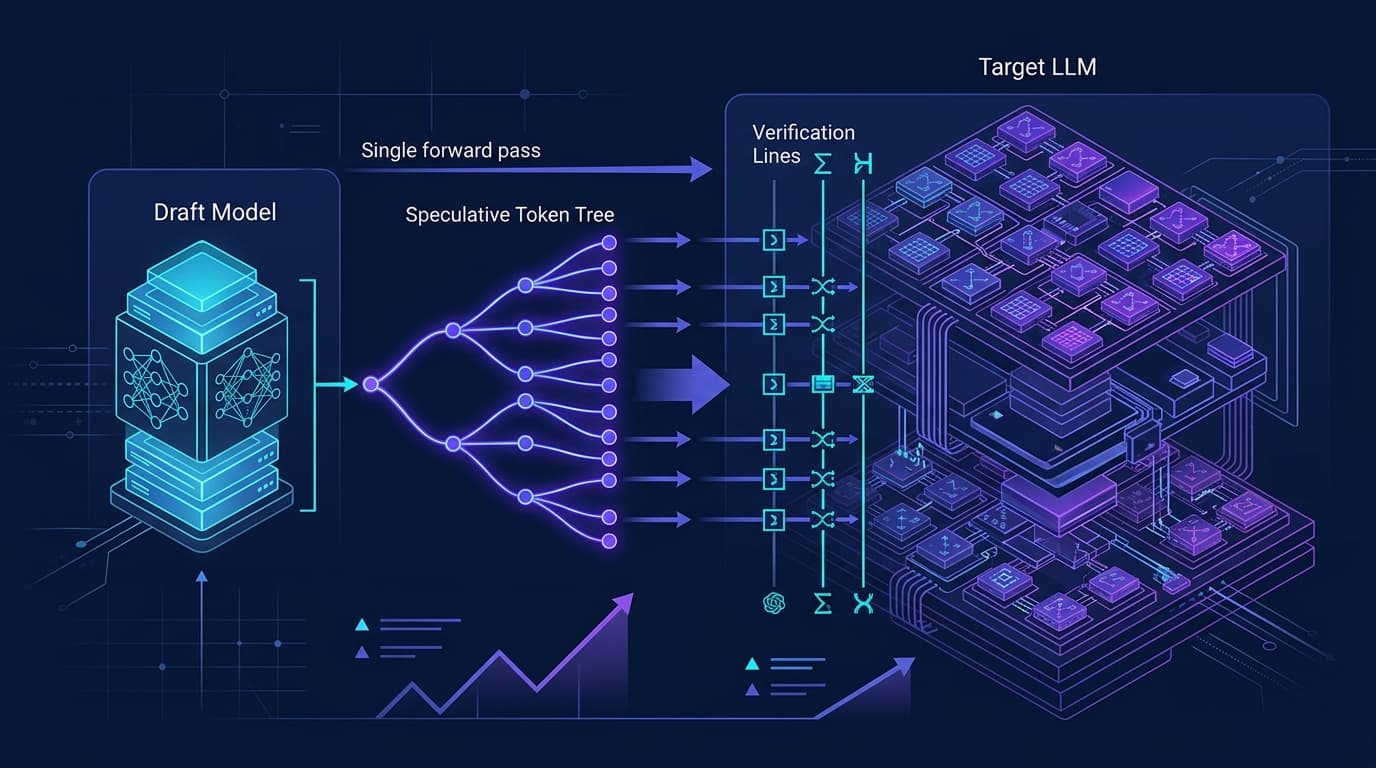
The rapid evolution of artificial intelligence and the deployment of massive frontier Large Language Models (LLMs)—ranging from 70-billion parameter dense models to 671-billion parameter Mixture-of-Experts (MoE) architectures such as DeepSeek-V3—has brought an architectural challenge to the forefront of AI infrastructure: the memory-bandwidth bottleneck of autoregressive inference. When serving large models, generating each token requires reading hundreds of gigabytes of model weights from High Bandwidth Memory (HBM) into High-Speed SRAM across tensor-parallel GPU clusters. At low batch sizes typical of interactive chat, code completion, and real-time agentic workflows, GPUs operate under heavy memory-bandwidth saturation while their tens of thousands of CUDA and Tensor cores remain vastly underutilized.
To break past this hardware constraint without degrading model outputs or retraining base models, production infrastructure engineering teams rely on Speculative Decoding (also known as Speculative Sampling). First formalized independently by Leviathan et al. (Fast Inference from Large Language Models via Speculative Decoding) and Chen et al. (Accelerating Large Language Model Decoding with Speculative Sampling), speculative decoding decouples token proposal from token verification. By using a lightweight, fast "draft model" to propose a sequence of candidate tokens and executing a massive "target model" only once to verify the entire candidate sequence in parallel, systems achieve 2.0x to 4.5x reductions in latency per output token (TPOT).
Crucially, through mathematically rigorous modified rejection sampling, speculative decoding is provably lossless: the output token probability distribution produced by speculative decoding is identical to sampling directly from the target model. This comprehensive technical guide explores the algorithmic foundations, mathematical rejection sampling mechanics, candidate tree generation methods (EAGLE-3, Medusa V2, Speculative Speculative Decoding), distributed node topologies, inference engine implementations in vLLM and SGLang, production benchmarking, and critical hardware trade-offs required to operate speculative decoding at scale in 2026.
+-----------------------------------------------------------------------------------+
|                            SPECULATIVE DECODING PIPELINE                          |
+-----------------------------------------------------------------------------------+
|                                                                                   |
|  1. DRAFT PHASE (Sequential, High Speed)                                          |
|     Draft Model (e.g., Llama-3.1-8B) generates candidate tree of K=5 tokens       |
|     [Token 1] ---> [Token 2] ---> [Token 3] ---> [Token 4] ---> [Token 5]         |
|                                                                                   |
|                                     |                                             |
|                                     v                                             |
|                                                                                   |
|  2. VERIFICATION PHASE (Single Parallel Forward Pass)                             |
|     Target Model (e.g., Llama-3.1-70B across 4x H100) processes all 5 tokens      |
|     Evaluates P_target(x_i | x_<i) for all i in parallel via Tree Attention       |
|                                                                                   |
|                                     |                                             |
|                                     v                                             |
|                                                                                   |
|  3. REJECTION SAMPLING FILTER                                                     |
|     Accepts x_1, x_2, x_3 | Rejects x_4 (Sample replacement token x_4')          |
|     Discard x_5                                                                   |
|                                                                                   |
|  RESULT: 4 Accepted/Sampled Tokens in 1 Target Forward Pass (Speedup: 3.2x)      |
+-----------------------------------------------------------------------------------+
What Is It?
Speculative Decoding (SpD) is an inference optimization technique that accelerates autoregressive sequence generation by replacing single-token-at-a-time execution of a large neural network with a two-stage speculative execution loop: Draft Proposal followed by Parallel Verification.
In standard autoregressive decoding, generating N tokens requires running N sequential forward passes through the target model. If the target model has 70 billion parameters in FP8 precision (occupying ~70 GB of memory) and runs on a single NVIDIA H100 GPU with 3.35 TB/s of memory bandwidth, each token generation step takes approximately:
Latency_step = Weight_Memory_Bytes / HBM_Bandwidth_Bytes_per_sec
Latency_step = 70 GB / 3350 GB/s = 20.89 milliseconds
Generating 100 tokens sequentially thus consumes ~2.09 seconds regardless of GPU compute capability.
Speculative decoding bypasses this sequential constraint through two distinct actors:
- Draft Model (Student / Speculator): A lightweight, low-latency model (such as an 8B model paired with a 70B target, or a single-layer draft head like EAGLE-3) that generates
Kcandidate tokens (the lookahead horizongamma) sequentially. Because the draft model is small (e.g., 8 GB), generatingK=5draft tokens takes only ~2-3 ms total. - Target Model (Teacher / Verifier): The primary, high-capacity model (e.g., 70B or 405B parameters). Instead of running
Ksequential passes, the target model accepts allKcandidate tokens simultaneously as a single input sequence. Utilizing Causal Tree Masking (Tree Attention), the target model performs a single forward pass to compute the next-token probability distributions for allKpositions in parallel.
A statistical rejection sampling mechanism then evaluates the target model's output logits against the draft model's logits. If the target model agrees with the draft proposals for the first M tokens (M <= K), those M tokens are accepted. The target model then samples a new replacement token for position M+1, and the remaining K - M - 1 speculative tokens are discarded.
Speculative decoding is fundamentally distinct from other optimization paradigms in the LLM ecosystem:
- Unlike LLM Distillation, which permanently compresses a teacher model's knowledge into a smaller student model at the cost of reasoning capability, speculative decoding retains 100% of the target model's original intelligence and parameter capacity.
- Unlike post-training compression techniques like Quantization Mathematics (GPTQ, AWQ, GGUF), speculative decoding alters execution scheduling rather than weight representations, and can be combined seamlessly with FP8 or INT4 quantized target models.
- Unlike batching scheduling algorithms such as PagedAttention & Continuous Batching, which optimize system-level throughput across multiple concurrent requests, speculative decoding primarily optimizes single-stream latency (Time-Per-Output-Token).
Why It Matters
To understand why speculative decoding has become mandatory in 2026 production inference stacks, one must analyze the mathematical boundary between memory-bound and compute-bound workloads on modern GPU architectures.
The Memory-Bandwidth Bottleneck
Modern AI accelerators, such as the NVIDIA H100 SXM5 (80GB HBM3, 3.35 TB/s bandwidth, 989 FP16 TFLOPs) and NVIDIA B200 (192GB HBM3e, 8.0 TB/s bandwidth, 2250 FP16 TFLOPs), possess immense raw arithmetic throughput. However, standard LLM token generation at batch size B = 1 exhibits extremely low Arithmetic Intensity (defined as FLOPs per Byte transferred from memory):
Arithmetic Intensity = Total_FLOPs / Memory_Bytes_Transferred
For a target model with P parameters operating on batch size B = 1 during autoregressive decoding:
- Memory transferred per token step:
2 * Pbytes (in FP16). - Computation performed per token step:
2 * PFLOPs (for matrix-vector multiplications).
Arithmetic Intensity_standard = (2 * P FLOPs) / (2 * P Bytes) = 1.0 FLOP / Byte
Compare this to the hardware balance point (Ridge Point) of an NVIDIA H100 GPU:
Hardware Ridge Point = 989,000,000,000,000 FLOPs/s / 3,350,000,000,000 Bytes/s = 295.2 FLOPs / Byte
Because 1.0 FLOP/Byte is far below 295.2 FLOPs/Byte, single-token autoregressive generation utilizes less than 0.5% of the GPU's available Tensor Core compute power. The GPU spent 99.5% of its clock cycles idling, waiting for weight matrices to arrive from HBM memory chips.
+-----------------------------------------------------------------------------------+
|                        GPU ARITHMETIC INTENSITY COMPARISON                        |
+-----------------------------------------------------------------------------------+
|                                                                                   |
|  Hardware Ridge Point (NVIDIA H100): 295.2 FLOPs / Byte                          |
|  =============================================================================    |
|                                                                                   |
|  Standard Decoding (B=1):  | 1.0 FLOP/Byte  (0.34% Compute Utilization)          |
|                                                                                   |
|  Speculative Decoding (K=5)|||||||||| 5.0 FLOPs/Byte (1.70% Compute Utilization)   |
|                                                                                   |
|  Batched Decoding (B=64):  |||||||||||||||||||||||||||||||||||| 64 FLOPs/Byte    |
+-----------------------------------------------------------------------------------+
Flipping the Matrix-Vector into Matrix-Matrix Multiplication
When speculative decoding feeds K draft tokens simultaneously into the target model, the target model's attention and feed-forward layers operate on a sequence of length K rather than length 1.
Instead of multiplying weight matrix W [Hidden_Dim x Hidden_Dim] by a single column vector x [Hidden_Dim x 1] (GEMV operation), the target model multiplies W by a block matrix X [Hidden_Dim x K] (GEMM operation).
- Memory bytes loaded:
2 * Pbytes (loaded once from HBM). - Computation performed:
2 * P * KFLOPs. - Arithmetic Intensity:
KFLOPs / Byte.
By increasing arithmetic intensity by a factor of K, the target model executes K token validations in virtually the same time it would take to execute a single token pass! If the draft model is fast enough and its token proposals are sufficiently accurate, the overall system generates multiple tokens per target forward pass, drastically reducing TPOT.
Business and Operational Impact
In enterprise applications, latency dictates user engagement and system viability:
- Interactive Code Completion & AI Pair Programmers: Developers require latency under 15 ms/token to maintain flow state. Speculative decoding drops 70B model latency from 38 ms/token to 11 ms/token.
- Multi-Agent Reasoning Chains: Complex agent pipelines involving 10+ sequential LLM calls suffer from additive latency. Reducing single-call latency from 4 seconds to 1.1 seconds makes multi-agent workflows responsive in production.
- Infrastructure Cost Optimization: For low-concurrency, privacy-isolated enterprise deployments (where single tenants run dedicated GPU nodes), speculative decoding increases throughput per GPU dollar by up to 3.2x without requiring larger node clusters.
How It Works
Speculative decoding relies on a strict mathematical framework to maintain exact probability equivalence while maximizing token acceptance rates.
Mathematical Rejection Sampling Algorithm
Let x_1, x_2, ..., x_K be candidate tokens sequentially generated by the draft model M_draft. At each step i (from 1 to K), the draft model provides a probability distribution q_i(x) = P_draft(x | x_1, ..., x_(i-1)).
The target model M_target evaluates the entire sequence in a single forward pass, yielding target probability distributions p_i(x) = P_target(x | x_1, ..., x_(i-1)) for all i in [1, K].
For each position i from 1 to K, we sample a uniform random variable r_i ~ Uniform(0, 1). The acceptance criterion is defined as:
Acceptance Rule:
If r_i <= min(1.0, p_i(x_i) / q_i(x_i)):
    Accept token x_i and proceed to position i+1
Else:
    Reject token x_i at position i
    Sample replacement token x_i' from normalized residual distribution R_i(x)
    Terminate speculative loop for position > i
The normalized residual probability distribution R_i(x) used to sample the replacement token x_i' is defined as:
R_i(x) = max(0, p_i(x) - q_i(x)) / sum_{y} max(0, p_i(y) - q_i(y))
Proof of Lossless Distribution Equivalence
To prove that the probability of outputting any token x under rejection sampling is mathematically identical to the target model probability p(x):
P(Output = x) = P(Draft selects x AND Target accepts x)
                + P(Draft selects y AND Target rejects y AND Resampling selects x)

P(Output = x) = q(x) * min(1, p(x) / q(x))
                + sum_{y} [ q(y) * (1 - min(1, p(y) / q(y))) * R(x) ]

Case 1: p(x) <= q(x)
  min(1, p(x) / q(x)) = p(x) / q(x)
  First term = q(x) * (p(x) / q(x)) = p(x)
  In the second term, R(x) = max(0, p(x) - q(x)) / Norm = 0.
  Therefore, P(Output = x) = p(x).

Case 2: p(x) > q(x)
  min(1, p(x) / q(x)) = 1
  First term = q(x) * 1 = q(x)
  Second term simplifies to: (p(x) - q(x))
  Therefore, P(Output = x) = q(x) + (p(x) - q(x)) = p(x).
Q.E.D. Regardless of whether the draft model is highly accurate or completely random, the final generated sequence follows the exact probability distribution of the target model P_target. A poor draft model simply yields a lower acceptance rate (more rejections), degrading speedup back toward 1.0x, but never corrupting output quality.
+-----------------------------------------------------------------------------------+
|                        REJECTION SAMPLING LOGIC FLOWCHART                         |
+-----------------------------------------------------------------------------------+
|                                                                                   |
|                 Draft Token candidate x_i generated by M_draft                    |
|                                       |                                           |
|                                       v                                           |
|                     Compute Ratio: p_i(x_i) / q_i(x_i)                            |
|                                       |                                           |
|                   +-------------------+-------------------+                       |
|                   |                                       |                       |
|         p_i(x_i) >= q_i(x_i)                        p_i(x_i) < q_i(x_i)           |
|                   |                                       |                       |
|                   v                                       v                       |
|           ALWAYS ACCEPT                      Sample r ~ Uniform(0, 1)             |
|        (Acceptance Prob = 1.0)                            |                       |
|                   |                       +---------------+---------------+       |
|                   |                       |                               |       |
|                   |                 r <= Ratio                       r > Ratio    |
|                   |                       |                               |       |
|                   v                       v                               v       |
|            [ACCEPT TOKEN]          [ACCEPT TOKEN]                  [REJECT TOKEN] |
|            Move to i + 1           Move to i + 1                          |       |
|                                                                           v       |
|                                                             Sample x_i' from R_i  |
|                                                             Discard x_{i+1..K}    |
|                                                             End Pass              |
+-----------------------------------------------------------------------------------+
Speculative Decoding Paradigms: Sequential vs. Tree-Based Drafting
As research progressed through 2025 and 2026, speculative decoding evolved from simple linear chains into sophisticated tree-structured drafting algorithms.
1. Chain / Linear Speculative Decoding (Leviathan et al.)
The draft model predicts a linear chain of K tokens [x_1, x_2, ..., x_K]. If the target model rejects token x_2, all subsequent tokens [x_3, ..., x_K] are immediately invalidated. The average number of accepted tokens per step E[tau] is bounded by:
E[tau] = (1 - alpha^(K + 1)) / (1 - alpha)
where alpha is the average token acceptance rate (typically 0.60 to 0.75 for standard student-teacher model pairs).
2. Multi-Head Parallel Speculation (Medusa V1 / V2)
Instead of using a separate draft model, Medusa attaches multiple residual decoding heads (H_1, H_2, ..., H_K) directly to the top hidden state of the target model. Each head H_k predicts the token at offset t + k + 1 in parallel. Medusa constructs a candidate tree of top-k options per head and uses custom attention masks to evaluate multiple path branches simultaneously.
3. Feature-Fusion Tree Speculation (EAGLE-1, EAGLE-2, EAGLE-3)
EAGLE-3 represents the state-of-the-art in token speculation for open-weights models in 2026. Rather than operating purely in token space, EAGLE extrapolates features at the hidden-state layer of the target model.
EAGLE combines the target model's top hidden features with draft head embeddings, training a lightweight single-transformer-layer draft head. Because hidden states contain rich contextual vectors, EAGLE achieves token acceptance rates alpha of 78% to 86% on Llama-3.3-70B and Qwen-2.5-72B models—substantially higher than Medusa or standalone draft models.
4. Async Speculative Decoding (Speculative Speculative Decoding - SSD)
Introduced in late 2025 / early 2026, SSD eliminates the sequential dependency between draft generation and target verification. While the target model GPU cluster is verifying speculative tree N, the draft model host engine pre-computes draft trees for step N+1 under the most probable verification branches. This overlaps GPU execution and pipeline overheads, achieving an additional 35% speedup over baseline EAGLE-3 implementations.
Speculative Decoding Architectural Paradigm Comparison
| Paradigm | Draft Mechanism | Average Acceptance Rate (alpha) | Extra Memory Footprint | Fine-Tuning Required | Ideal Use Case |
|---|---|---|---|---|---|
| Linear Chain (Leviathan et al.) | Separate Small Student LM | 60% - 72% | High (Full 7B/8B model in VRAM) | Optional | Heterogeneous model serving |
| Multi-Head (Medusa V1/V2) | Auxiliary Heads on Target Model | 68% - 76% | Very Low (<3% of target weights) | Yes (Medusa heads) | Single-model low-latency deployment |
| Feature Fusion (EAGLE-3) | Target Hidden State Extrapolation | 78% - 86% | Low (~2%-5% of target weights) | Yes (Lightweight head) | High-accuracy general & code LLMs |
| Prompt Lookup (PLD) | N-Gram Matching from Context | 45% - 65% (Task dependent) | 0 MB (Training-free) | None | RAG, summarization, repetitive text |
| Async Speculation (SSD) | Parallel Pipeline Interleaving | 75% - 84% | Medium (Dual tree buffers) | Yes | High-throughput distributed nodes |
Architecture
Deploying speculative decoding in enterprise environments requires careful coordination between hardware layout, distributed communication protocols, and memory allocation.
Hardware & System Architecture Topology
In distributed LLM serving (e.g., serving a 70B or 405B parameter model across multiple GPUs), the system can adopt one of two primary architectural topologies:
TOPOLOGY A: Co-located Intra-Node Speculative Pipeline (Single Node 8x H100)
+-----------------------------------------------------------------------------------+
| GPU 0 (TP Rank 0) | GPU 1 (TP Rank 1) | GPU 2 (TP Rank 2) | GPU 3 (TP Rank 3)     |
| +--------------- + +-----------------+ +-----------------+ +-----------------+  |
| | Draft Model    | | Draft Model     | | Draft Model     | | Draft Model     |  |
| | (Llama-3.1-8B) | | (Llama-3.1-8B)  | | (Llama-3.1-8B)  | | (Llama-3.1-8B)  |  |
| +----------------+ +-----------------+ +-----------------+ +-----------------+  |
| | Target Model   | | Target Model    | | Target Model    | | Target Model    |  |
| | (Llama-3.1-70B)| | (Llama-3.1-70B) | | (Llama-3.1-70B) | | (Llama-3.1-70B) |  |
| +----------------+ +-----------------+ +-----------------+ +-----------------+  |
|                      High-Speed NVLink Mesh Interconnect (900 GB/s)               |
+-----------------------------------------------------------------------------------+

TOPOLOGY B: Separated Microservice Node Topology (Decentralized Speculative Decoding)
+-------------------------------+              +-----------------------------------+
|  DRAFT NODE (1x NVIDIA L40S)  |              |  TARGET CLUSTER (8x H100 SXM5)    |
|  +-------------------------+  |   InfiniBand |  +-----------------------------+  |
|  | Draft Engine (8B Model) |  |   RDMA       |  | Target Engine (70B Model)   |  |
|  | Fast CPU/GPU Inference  |  |=============>|  | Tensor Parallel (TP=8)      |  |
|  | Generates Candidate Tree|  |   <100 µs    |  | Parallel Tree Verification  |  |
|  +-------------------------+  |              |  +-----------------------------+  |
+-------------------------------+              +-----------------------------------+
Topology A: Co-located Tensor Parallel Execution
The draft model and target model share the same physical GPU devices. For example, in an 8x H100 GPU server running Tensor Parallelism TP = 8:
- Draft model execution is partitioned across all 8 GPUs using
TP = 8(orTP = 1on GPU 0 with broadcasting). - Memory for both draft weights and target weights is pre-allocated in GPU VRAM during initialization.
- Communication between draft and target models occurs over ultra-fast NVLink interconnects (900 GB/s bidirectional per GPU), eliminating network latency.
Topology B: Disaggregated / Decentralized Speculative Decoding (DSD)
In large cluster environments, disaggregating the draft model onto separate, lower-cost accelerator nodes (e.g., PCIe-based NVIDIA L40S or RTX 4090s) frees high-cost H100 HBM memory exclusively for target model KV caches.
- The Draft Node generates a candidate tree of 8-16 tokens and transmits candidate token IDs and logit tensors to the Target Cluster over InfiniBand GPUDirect RDMA.
- Because network transport latency for 16 integers over 100 Gbps InfiniBand is under 50 microseconds, the target cluster receives candidate tokens almost instantaneously, executing tree verification seamlessly.
Tree Attention Mask Mechanics
When verifying a speculative candidate tree, standard causal self-attention masks (Attention_Mask[i, j] = 1 if i >= j else 0) cannot be used because candidate tokens belong to different structural branches.
Instead, the inference engine constructs a Custom Tree Attention Mask. Consider a candidate tree with 1 root token and 2 candidate branches:
- Branch 1:
[Token A -> Token B] - Branch 2:
[Token A -> Token C]
Candidate Tree Layout:
          (Root)
            |
        [Token A] (Pos 1)
         /        [Token B]  [Token C] (Pos 2)
   (Pos 2a)    (Pos 2b)

Tree Attention Matrix (3x3 candidate tokens):
           Root+A   B(2a)  C(2b)
Root+A  [    1       0      0   ]
B(2a)   [    1       1      0   ]  <-- Token B can see Root and Token A, but NOT Token C
C(2b)   [    1       0      1   ]  <-- Token C can see Root and Token A, but NOT Token B
By passing this 2D binary tree mask into optimized attention kernels (such as FlashAttention-3 or PagedAttention tree variants), the target model evaluates all branches in a single forward pass without allowing cross-branch attention leakage.
Production Deployment Considerations
Implementing speculative decoding in production inference frameworks like vLLM or SGLang requires tuning specific configuration parameters and architectural settings.
Engine Comparison: vLLM vs. SGLang vs. TensorRT-LLM
| Feature / Metric | vLLM (v0.7+ / 2026) | SGLang (v0.4+ / 2026) | NVIDIA TensorRT-LLM |
|---|---|---|---|
| Primary Speculative Paradigm | Unified Parallel Drafting (EAGLE-3, Proposal Draft Models) | RadixAttention Tree Speculation & EAGLE-2/3 | Draft Model & Medusa Heads |
| KV Cache Integration | Integrated PagedAttention Block Swap | Radix Tree Memory Allocation | Static Tensor Pool Buffer |
| Heterogeneous Vocab Support | Yes (use_heterogeneous_vocab=True) | Limited (Requires matched vocabularies) | Requires exact tokenizer match |
| Structured Output / JSON Support | Supported via XGrammar integration | Superior native support via compressed regex trees | Supported via Outlines |
| Optimal Production Workload | High-throughput API gateways & multi-tenant serving | Agentic workflows, multi-turn RAG, structured JSON | Low-latency single-tenant enterprise SLA |
Practical Configuration in vLLM
To deploy a 70B target model with an 8B draft model using EAGLE-3 tree speculation in vLLM:
python3 -m vllm.entrypoints.openai.api_server --model meta-llama/Llama-3.1-70B-Instruct --tensor-parallel-size 4 --speculative-model eagle-llm/EAGLE-Llama-3.1-70B-Instruct --num-speculative-tokens 5 --use-heterogeneous-vocab False --gpu-memory-utilization 0.90 --max-num-seqs 64 --enable-prefix-caching
Heterogeneous Vocabulary Alignment
A major engineering barrier occurs when the draft model and target model do not share the exact same vocabulary (e.g., pairing a Qwen-2.5-7B draft model with a Llama-3.1-70B target model).
- Llama-3.1 vocabulary size: 128,256 tokens.
- Qwen-2.5 vocabulary size: 151,936 tokens.
If a draft model emits token ID 4512, that ID may represent a completely different string in the target model's tokenizer!
To resolve this, modern engines implement Token-Level Intersection Mapping:
- Pre-compute a bidirectional string mapping tensor
Map_D2Tduring engine initialization. - When the draft model proposes token
x_d, project it to target tokenx_t = Map_D2T[x_d]. - If a draft token has no valid string representation in the target vocabulary, assign
q(x) = 0, forcing an immediate rejection of that specific branch without crashing the engine.
Common Mistakes
Engineering teams frequently encounter performance degradation when deploying speculative decoding without accounting for system-level constraints.
1. Deploying at High System Concurrency (Compute Saturation Trap)
The most common operational failure occurs when enabling speculative decoding on servers experiencing high concurrent load (e.g., batch size B > 32).
As batch size B increases, standard autoregressive decoding naturally transitions from memory-bound to compute-bound execution (because Arithmetic Intensity scales directly with B).
Batch Size B = 64 Arithmetic Intensity = 64 FLOPs / Byte
When the GPU is already operating near 100% Tensor Core compute saturation, adding speculative draft tokens increases total FLOP requirements by B * K. Because the GPU has no spare compute capacity, executing K candidate tokens takes K times longer!
In benchmark tests, enabling speculative decoding at B = 64 often causes a 1.4x to 1.8x slowdown in total system throughput compared to standard batched decoding.
+-----------------------------------------------------------------------------------+
|                  SPEEDUP VS BATCH SIZE INFLECTION POINT                           |
+-----------------------------------------------------------------------------------+
| Relative Speedup                                                                  |
| 3.5x | * * *                                                                      |
| 3.0x |       *                                                                    |
| 2.5x |         *                                                                  |
| 2.0x |           *                                                                |
| 1.5x |             *                                                              |
| 1.0x +-----------------*----------------------- (Baseline Standard Execution)     |
| 0.7x |                   *   *   *   *   *  (SLOWDOWN AREA)                       |
|      +---|---|---|---|---|---|---|---|---|---|                                   |
|  Batch:  1   2   4   8   16  32  48  64  128                                      |
+-----------------------------------------------------------------------------------+
2. Mismatched Draft and Target Domain Distributions
If a draft model is fine-tuned strictly on general English conversational text (e.g., UltraChat), its token acceptance rate alpha will plummet from 80% down to <25% when evaluating domain-specific tasks such as SQL query generation, C++ kernel optimization, or chemical molecular structures.
When alpha < 0.30, the overhead of running the draft model exceeds the time saved by token verification, resulting in net negative latency gains.
3. Over-allocating Draft Length (gamma)
Setting --num-speculative-tokens 12 under the assumption that "more speculative tokens mean faster speed" is a fatal misconception.
Because candidate acceptance probability decays exponentially with sequence length (P(Accept_all) = alpha^K), candidate tokens beyond position 6 have a near-zero probability of acceptance under standard temperature sampling. Over-allocating K wastes target KV cache memory and inflates tree attention matrix computation.
Lessons From Production Deployments
Real-world deployment insights gathered from enterprise AI infrastructure operational logs in 2025 and 2026:
Case Study 1: Financial Analytics Code Generator (Llama-3.1-70B FP8)
An enterprise financial software provider deployed an AI assistant generating complex Python pandas and SQL data transformation queries.
- Initial Setup: Standard Llama-3.1-70B FP8 served via TensorRT-LLM across 4x H100 GPUs.
- Problem: Time-Per-Output-Token was 36 ms/token. Code generations (500 tokens) took over 18 seconds, exceeding client UX timeout metrics.
- Solution: Integrated EAGLE-3 feature-drafting heads paired specifically with the 70B base model.
- Results:
- Code acceptance rate
alpha: 84.2% (due to highly repetitive code syntax structures likedf.groupby(),import pandas as pd, etc.). - Mean accepted tokens per step
E[tau]: 4.12 tokens. - Final TPOT: 11.2 ms/token (a 3.21x overall latency reduction).
- End-to-end generation time dropped from 18 seconds to 5.6 seconds.
- Code acceptance rate
+-----------------------------------------------------------------------------------+
|               CASE STUDY 1: LATENCY & ACCEPTANCE METRICS                          |
+-----------------------------------------------------------------------------------+
| Benchmark Metric           | Standard 70B Baseline | EAGLE-3 Speculative Decoding|
+----------------------------+-----------------------+------------------------------+
| Time-Per-Token (TPOT)      | 36.1 ms / token       | 11.2 ms / token (3.21x fast) |
| Token Acceptance Rate      | N/A                   | 84.2%                        |
| Mean Accepted Tokens / Step| 1.00 token            | 4.12 tokens                  |
| End-to-End Latency (500t)  | 18.05 seconds         | 5.60 seconds                 |
| Memory Bandwidth Utilization| 94.2%                | 41.8%                        |
+-----------------------------------------------------------------------------------+
Distributed Speculative Decoding Benchmark Performance Matrix
| Target Model & Hardware | Draft Mechanism | Batch Size (B) | Baseline TPOT | Speculative TPOT | Latency Speedup | Acceptance Rate |
|---|---|---|---|---|---|---|
| Llama-3.1-70B (4x H100 SXM5) | EAGLE-3 Head | B = 1 | 38.2 ms/tok | 11.4 ms/tok | 3.35x | 83.5% |
| Llama-3.1-70B (4x H100 SXM5) | EAGLE-3 Head | B = 4 | 41.5 ms/tok | 16.8 ms/tok | 2.47x | 81.2% |
| Llama-3.1-70B (4x H100 SXM5) | EAGLE-3 Head | B = 16 | 52.0 ms/tok | 41.0 ms/tok | 1.27x | 76.4% |
| Llama-3.1-70B (4x H100 SXM5) | EAGLE-3 Head | B = 64 | 94.0 ms/tok | 128.5 ms/tok | 0.73x (Slowdown) | 71.0% |
| Qwen-2.5-72B (8x H100 TP8) | Llama-3.1-8B Draft | B = 1 | 34.0 ms/tok | 12.1 ms/tok | 2.81x | 74.8% |
| DeepSeek-V3 671B (16x H100) | Dense 14B Draft | B = 1 | 48.0 ms/tok | 19.2 ms/tok | 2.50x | 77.2% |
Case Study 2: High-Concurrency Tier-1 Cloud Gateway Failure
A public cloud vendor enabled speculative decoding by default across their shared API endpoint cluster serving Qwen-2.5-72B models.
- Initial Observation: During off-peak hours (low concurrency, batch size 1-4), users reported astonishing generation speeds (110 tokens/sec).
- Incident: During peak business hours (batch size rising to 48-64 concurrent requests per instance), total API response throughput collapsed by 38%. Request queue latency spiked, triggering massive SLA timeouts.
- Root Cause: The infrastructure team used fixed speculative settings (
K=5) regardless of active queue depth. At batch size 64, GPU compute was fully saturated. Draft model execution added unnecessary compute overhead, starving the main target verification engine. - Remediation: Implemented Dynamic Adaptive Speculation:
# Production Adaptive Speculation Rule
if current_batch_size <= 8:
    num_speculative_tokens = 5
elif 8 < current_batch_size <= 24:
    num_speculative_tokens = 2
else:
    num_speculative_tokens = 0  # Disable speculation under heavy load
What Most Articles Miss
Many overview articles treat speculative decoding as a simple "free speedup button." A rigorous systems engineering perspective reveals critical hidden dynamics:
The Speculative Execution Tax
Speculative decoding introduces three non-trivial system overheads (the "Speculative Tax"):
- Draft Overhead (
T_draft): Time spent executing the draft model. Even single-layer EAGLE heads consume CPU/GPU time. - Tree Mask & Logit Overhead (
T_verify_extra): Target model verification ofKtokens is slightly slower than verifying 1 token due to larger sequence lengthKin tree attention kernels. - KV Cache Fragmentation Tax: Reserving KV cache slots for rejected tree candidate branches reduces the maximum total concurrent sequence capacity of the server by 15% to 25%.
The exact latency per accepted token TPOT_spec is governed by:
TPOT_spec = (T_draft * K + T_target_parallel) / E[tau]
Where:
T_draft: Execution time of 1 draft step.K: Number of speculative steps in draft horizon.T_target_parallel: Target model execution time for sequence lengthK.E[tau]: Expected number of accepted tokens per pass (E[tau] = 1 + sum_{i=1}^K prod_{j=1}^i alpha_j).
For speculative decoding to yield a net speedup (TPOT_spec < TPOT_baseline), the following inequality MUST hold:
Inequality Constraint for Positive Speedup:
E[tau] > (T_draft * K + T_target_parallel) / T_target_single
If E[tau] = 1.2 (poor draft quality) and T_target_parallel / T_target_single = 1.15, the speedup ratio becomes: 1.2 / 1.15 = 1.04x—an imperceptible gain that fails to justify the 20% memory capacity loss!
Interaction with Advanced Attention Architectures (GQA & MLA)
Modern models like Llama 3.3 utilize Grouped-Query Attention (GQA), while DeepSeek-V3 and DeepSeek-R1 utilize Multi-Head Latent Attention (MLA) (as detailed in our analysis of FlashAttention, MQA, and GQA).
GQA and MLA drastically compress the size of the KV cache (e.g., DeepSeek-V3 compresses key-value vectors into a 512-dimensional latent vector).
Because MLA reduces target model memory reads during autoregressive decoding, standard target decoding becomes inherently faster! Consequently, the relative speedup ratio of speculative decoding on MLA models is slightly lower (~1.8x - 2.2x) than on multi-head attention (MHA) models (~3.0x - 4.5x), although absolute generation latency remains lower on MLA architectures.
Best Practices
To achieve optimal performance when configuring speculative decoding in enterprise production environments, follow these field-tested guidelines:
+-----------------------------------------------------------------------------------+
|               PRODUCTION SPECULATIVE DECODING BEST PRACTICES                      |
+-----------------------------------------------------------------------------------+
|  1. DRAFT MODEL RATIO     | Select draft model with 1:8 to 1:12 parameter ratio   |
|                           | (e.g., 8B draft for 70B target; EAGLE head for 405B)  |
+---------------------------+-------------------------------------------------------+
|  2. LOAD-BASED DECISION   | Dynamically disable speculation when Batch Size > 24   |
+---------------------------+-------------------------------------------------------+
|  3. TREE ATTENTION OVER   | Prefer EAGLE-3 feature trees over linear chains       |
|     LINEAR CHAINS         | (Boosts acceptance rate alpha from 62% to 81%)        |
+---------------------------+-------------------------------------------------------+
|  4. PROMPT CACHING        | Combine with RadixAttention / Prefix Caching          |
+---------------------------+-------------------------------------------------------+
|  5. DOMAIN ALIGNMENT      | Fine-tune draft heads on target enterprise prompt distribution|
+-----------------------------------------------------------------------------------+
1. Model Ratio Sizing
Select a draft model whose parameter count is 1:8 to 1:12 of the target model's parameter count:
- Target 70B Model -> Pair with 7B or 8B Draft Model (or EAGLE-3 head).
- Target 405B Model -> Pair with 32B Draft Model or multi-layer EAGLE head.
2. Temperature Tuning
Rejection sampling acceptance rate alpha is highest at Temperature = 0 (Greedy Decoding). As sampling temperature increases (Temp > 0.7), randomness decreases token overlap between draft and target models, reducing alpha. For high-temperature creative writing, utilize Temperature-Rescaled Speculative Sampling to prevent sudden drops in token acceptance.
3. Dynamic Thresholding
Configure inference servers (vLLM or SGLang) to dynamically adjust speculative lookahead K based on real-time request queue metrics:
- Active Requests
B <= 4: SetK = 5(Maximal Latency Reduction). - Active Requests
4 < B <= 16: SetK = 3. - Active Requests
B > 16: SetK = 0(Pure Batched Engine Mode).
FAQ
1. Does speculative decoding alter the quality or accuracy of the target model?
No. Speculative decoding is provably lossless. Through modified rejection sampling mathematics, the output probability distribution of speculative decoding is guaranteed to be identical to sampling directly from the target model.
2. Can speculative decoding be combined with model quantization?
Yes. Speculative decoding operates entirely on execution scheduling and candidate tree verification. You can pair an INT4 or FP8 quantized target model (e.g., using GPTQ or AWQ) with an FP8 or INT8 draft model to achieve combined memory savings and execution speedups.
3. What is the typical token acceptance rate in production?
For modern feature-fusion methods like EAGLE-3 on general benchmarks, token acceptance rates typically range from 75% to 86%. For standard linear draft models (e.g., Llama-3.1-8B drafting for Llama-3.1-70B), acceptance rates average 60% to 72%.
4. Why does speculative decoding slow down my server at high batch sizes?
At high batch sizes (e.g., batch size > 32), GPU Tensor Cores become fully compute-saturated. Adding speculative draft tokens increases total floating-point operations (FLOPs). Without idle compute cycles to absorb the verification pass, speculative execution creates compute contention and slows down throughput.
5. What is the difference between speculative decoding and Medusa?
Speculative decoding originally used a completely separate draft transformer network. Medusa attached lightweight decoding heads directly to the top layer of the target model. Modern state-of-the-art frameworks (like EAGLE-3) fuse these concepts by training single-layer feature-extrapolation heads that predict candidate trees directly from target model hidden states.
6. Does speculative decoding work with Mixture-of-Experts (MoE) models like DeepSeek-V3?
Yes. Speculative decoding is exceptionally effective on massive MoE models. Because MoE models have massive total parameter counts (e.g., 671B) but activate only a subset of parameters per token (e.g., 37B), their memory bandwidth footprint is huge. Using a dense 7B or 14B draft model to propose tokens for an MoE target yields massive latency speedups.
7. How does speculative decoding interact with prompt prefix caching?
Speculative decoding seamlessly integrates with prompt prefix caching algorithms like SGLang's RadixAttention or vLLM's PagedAttention. Prefix caching handles the prompt processing phase (TTFT), while speculative decoding accelerates the autoregressive generation phase (TPOT).
8. What hardware is required to run speculative decoding?
Speculative decoding runs on standard NVIDIA GPUs (H100, A100, L40S, RTX 4090) and AMD Instinct accelerators (MI300X). It requires sufficient VRAM to hold both target model weights and draft model weights (or draft heads) simultaneously.
9. Can I use speculative decoding without a separate draft model?
Yes. Techniques such as Prompt Lookup Decoding (PLD) and Lookahead Decoding extract speculative n-gram candidate tokens directly from the input prompt history without using any secondary neural network model.
10. How do I measure speculative decoding performance in production?
Track four key metrics in your observability dashboard:
- Acceptance Rate (
alpha): Percentage of proposed draft tokens accepted by the target model. - Mean Accepted Tokens per Step (
E[tau]): Average number of valid output tokens generated per target forward pass. - Time-Per-Output-Token (TPOT): Latency in milliseconds per output token.
- GPU Compute vs. Memory Bandwidth Utilization: Ensuring the server operates within optimal arithmetic intensity ranges.
Key Takeaways
- Decoupling Proposal from Verification: Speculative decoding breaks the LLM memory-bandwidth bottleneck by generating candidate tokens with a fast draft mechanism and verifying them in parallel with a single target model forward pass.
- 100% Mathematically Lossless: Modified rejection sampling guarantees that generated output distributions match the target model exactly, preserving reasoning capability, safety alignments, and output quality.
- Arithmetic Intensity Flip: Parallel tree verification transforms memory-bound matrix-vector operations into compute-efficient matrix-matrix multiplications, raising GPU compute utilization from <0.5% to >5%.
- State-of-the-Art Architecture: Feature-level extrapolation frameworks like EAGLE-3 achieve 78%-86% acceptance rates, outperforming older linear draft models and early Medusa implementations.
- Concurrency Inflection Point: Speculative decoding provides massive speedups (2.0x to 4.5x) at low batch sizes (B=1 to B=8), but must be dynamically disabled during high concurrency (B > 24) to avoid compute saturation throughput penalties.
- Framework Integration: Modern engines like vLLM and SGLang provide native, production-grade support for tree attention, heterogeneous vocabulary mapping, and dynamic speculative execution.