Understanding Bias and Demographic Parity in Tabular ML Models
Mathematical approaches to identify, measure, and mitigate predictive bias in training datasets.

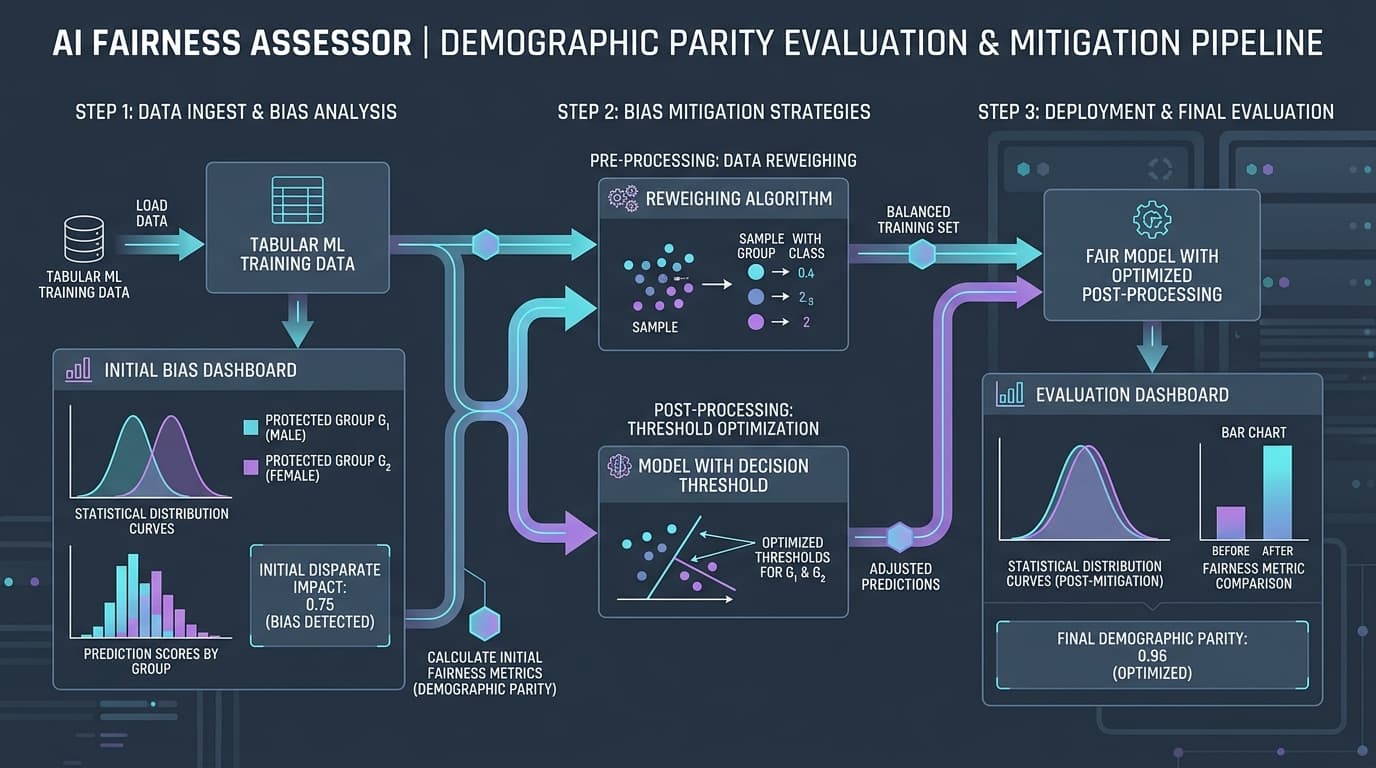
As machine learning systems govern critical decision-making pipelines across banking, credit scoring, hiring, insurance underwriting, and healthcare triaging, the auditing of algorithmic bias has transitioned from an academic exercise into a strict regulatory requirement. Under frameworks such as the EU Artificial Intelligence Act (2026 enforcement guidelines) and the U.S. Equal Credit Opportunity Act (ECOA), organizations deploying tabular predictive models face severe compliance penalties and reputational risks if their models display discriminatory output distributions.
While deep learning and large language models dominate headlines, over 80% of enterprise predictive applications rely heavily on tabular datasets processed through gradient boosting decision trees like XGBoost, LightGBM, and CatBoost. Tabular datasets present unique fairness challenges: historical human bias is baked directly into numerical features, sensitive attributes (such as gender, race, or age) are frequently encoded implicitly through highly correlated proxy features (such as ZIP code or credit line age), and traditional objective functions prioritize global accuracy at the expense of subgroup fairness.
This guide explores the mathematical foundations of algorithmic bias in tabular ML, provides rigorous definitions of Demographic Parity alongside complementary metrics like Equalized Odds and Equal Opportunity, demonstrates pre-processing, in-processing, and post-processing mitigation algorithms, and outlines an end-to-end production architecture for continuous bias monitoring.
What Is It?
In predictive machine learning, Demographic Parity (also referred to as Statistical Parity) is a foundational group fairness metric requiring that the probability of receiving a positive model prediction is independent of an individual's membership in a protected or sensitive demographic group.
Mathematically, let X represent the input feature vector, Y represent the true binary target label (Y in {0, 1}), Y_hat represent the model's binary prediction (Y_hat in {0, 1}), and A represent a protected categorical attribute (A in {0, 1} or A in {a_1, a_2, ..., a_k}).
Demographic Parity is satisfied if and only if:
P(Y_hat = 1 | A = 0) = P(Y_hat = 1 | A = 1)
In plain language: a credit scoring model satisfies Demographic Parity if the approval rate for loan applicants in Group A (A = 0) is identical to the approval rate for applicants in Group B (A = 1), regardless of the underlying ground-truth distribution of actual default rates (Y) between the two groups.
Core Quantification Metrics
In practical data science workflows, perfect equality between subgroup selection rates is rarely achieved due to finite sample variance. Thus, fairness toolkits measure Demographic Parity using two primary metrics:
- Demographic Parity Difference (DPD): The absolute difference between the highest and lowest selection rates across all demographic groups.
DPD = | P(Y_hat = 1 | A = a) - P(Y_hat = 1 | A = b) |
A model is perfectly fair under DPD when DPD = 0.0. In enterprise production benchmarks, a threshold of DPD < 0.05 (a 5 percentage point difference) is commonly enforced as an acceptable tolerance.
- Disparate Impact Ratio (DIR) / Demographic Parity Ratio (DPR): The ratio of the selection rate of the unprivileged group relative to the selection rate of the privileged group.
DIR = P(Y_hat = 1 | A = unprivileged) / P(Y_hat = 1 | A = privileged)
This formulation maps directly to the legally established "80% Rule" (Four-Fifths Rule) used by the U.S. Equal Employment Opportunity Commission (EEOC). If DIR < 0.80, the predictive system is legally presumed to exhibit disparate impact against the unprivileged group.
Why It Matters
Implementing bias auditing and Demographic Parity constraints in tabular ML pipelines is critical for three reasons:
1. Regulatory Compliance and Legal Vulnerability
Regulatory agencies globally have established stringent mandates governing automated decision systems:
- EU AI Act (2026): Classifies tabular AI models used in recruitment, credit evaluation, and law enforcement as "High-Risk AI Systems," requiring mandatory data governance, bias testing, and continuous post-market monitoring.
- U.S. FTC & CFPB Circulars: Clarify that machine learning algorithms utilizing proxy variables that result in disparate impact violate federal lending laws, even if the model developer did not explicitly include protected attributes in the feature matrix.
2. Preventing Feedback Loops in Historical Data
Tabular ML models trained on historical data learn to mirror past human biases. For example, if historical loan officers approved mortgages for a privileged group at a 70% rate while rejecting an equally qualified unprivileged group at a 40% rate, a gradient boosted tree trained without fairness constraints will codify this historical discrepancy into decision thresholds. When deployed, the model perpetuates the imbalance, generating fresh historical data that reinforces the bias in future MLOps retraining pipelines.
3. Mitigating Proxy Variable Risk ("Fairness Through Unawareness" Fallback)
A common misconception among engineering teams is that simply removing protected features (e.g., dropping gender or race columns) prevents algorithmic bias. In tabular datasets, complex interactions between non-sensitive features (e.g., zip_code, undergraduate_university, years_in_current_residence, credit_card_type) act as high-capacity reconstruction proxies for protected attributes. Without explicit fairness evaluation metrics like Demographic Parity, models remain biased despite "awareness masking."
How It Works
To evaluate and enforce Demographic Parity, practitioners must understand how Demographic Parity compares to alternative fairness criteria, how tabular features encode bias, and how pre-, in-, and post-processing algorithms alter model mechanics.
Demographic Parity vs. Alternative Fairness Definitions
Fairness in machine learning is not a single mathematical definition. Selecting Demographic Parity over other metrics involves explicit trade-offs regarding ground-truth reliance.
| Fairness Metric | Mathematical Formulation | Focus / Objective | Core Assumption / Trade-off |
|---|---|---|---|
| Demographic Parity | P(Y_hat=1 | A=a) = P(Y_hat=1 | A=b) | Equal selection rate across groups regardless of Y | Assumes historical ground-truth Y may be inherently biased or flawed. |
| Equal Opportunity | P(Y_hat=1 | Y=1, A=a) = P(Y_hat=1 | Y=1, A=b) | Equal True Positive Rate (TPR) among qualified individuals | Protects qualified candidates; permits disparate overall selection rates if base rates differ. |
| Equalized Odds | TPR_a = TPR_b AND FPR_a = FPR_b | Equal True Positive Rate (TPR) and False Positive Rate (FPR) across groups | Requires comprehensive parity across both positive and negative prediction errors. |
| Predictive Parity | P(Y=1 | Y_hat=1, A=a) = P(Y=1 | Y_hat=1, A=b) | Equal Positive Predictive Value (PPV / Precision) across groups | Ensures model confidence scores mean the same thing for all groups. |
Impossibility Theorem of Fairness: As proven by Kleinberg et al. (2017) and Chouldechova (2017), it is mathematically impossible for a predictive model to satisfy Demographic Parity, Equalized Odds, and Predictive Parity simultaneously whenever the baseline base rates
P(Y=1 | A=a)andP(Y=1 | A=b)differ across demographic groups. Engineering teams must explicitly select the metric aligned with their domain's legal and ethical requirements.
Taxonomy of Bias Mitigation Techniques
Bias mitigation can be introduced at three distinct stages of the tabular ML lifecycle:
+-----------------------------------------------------------------------------------+
|                            TABULAR ML BIAS MITIGATION PIPELINE                     |
+-----------------------------------------------------------------------------------+
|                                                                                   |
|  1. PRE-PROCESSING (Data Layer)                                                   |
|     +-----------------------+     +-----------------------+                       |
|     |  Raw Tabular Dataset  | --> | Reweighing / Sampling | --> Balanced Data     |
|     +-----------------------+     +-----------------------+                       |
|                                                                    |              |
|  2. IN-PROCESSING (Model Training Layer)                           v              |
|     +-----------------------------------------------------------------+           |
|     | Fairness-Constrained Loss (Fairlearn Reductions / Adversarial)  |           |
|     +-----------------------------------------------------------------+           |
|                                                                    |              |
|  3. POST-PROCESSING (Inference Output Layer)                       v              |
|     +-----------------------------------------------------------------+           |
|     | Group-Specific Threshold Optimization (ThresholdOptimizer)     |           |
|     +-----------------------------------------------------------------+           |
|                                                                    |              |
|                                                                    v              |
|                                                         Fair Final Predictions    |
+-----------------------------------------------------------------------------------+
- Pre-Processing (Data-level): Modifies the training dataset prior to model fitting.
- Reweighing: Assigns sample weights
w_ito training instances based on their joint group membershipAand target classY, neutralizing statistical correlation without altering feature values. - Disparate Impact Remover: Edits numerical feature values per group to align their cumulative distribution functions (CDFs) while preserving rank order within groups.
- Reweighing: Assigns sample weights
- In-Processing (Model-level): Modifies the objective function or optimization algorithm during model training.
- Fairlearn Exponentiated Gradient: Solves a constrained optimization problem by iteratively training a sequence of base estimators (e.g., XGBoost decision trees) weighted by Lagrange multipliers enforcing
DPD < epsilon. - Adversarial Debiasing: Trains a primary neural network to predict
Ywhile simultaneously training an adversarial network attempting to predictAfrom the primary model's latent embeddings.
- Fairlearn Exponentiated Gradient: Solves a constrained optimization problem by iteratively training a sequence of base estimators (e.g., XGBoost decision trees) weighted by Lagrange multipliers enforcing
- Post-Processing (Inference-level): Modifies output probability thresholds for each demographic group post-hoc.
- Threshold Optimizer: Solves a linear program to calculate distinct decision boundaries
tau_aandtau_bfor raw probability scoresP(Y_hat=1 | X), guaranteeing equal selection rates across groups without retraining base models.
- Threshold Optimizer: Solves a linear program to calculate distinct decision boundaries
Architecture
To systematically detect and mitigate bias in production tabular ML systems, organizations require a modular architecture that separates feature extraction, fairness computation, model training, and real-time decisioning.
+----------------------------------------------------------------------------------------------+
|                         PRODUCTION FAIRNESS AUDITING & MITIGATION ARCHITECTURE               |
+----------------------------------------------------------------------------------------------+
|                                                                                              |
|   +-----------------------+          +------------------------+                              |
|   | Enterprise Data Store | -------> | Feature Store (Feast)  |                              |
|   | (Snowflake / BigQuery)|          | - Entity Identifiers   |                              |
|   +-----------------------+          | - Sensitive Attribute A|                              |
|                                      +------------------------+                              |
|                                                   |                                          |
|                                                   v                                          |
|                                      +------------------------+                              |
|                                      | Bias Audit Pipeline    |                              |
|                                      | - Calculate DPD & DIR  |                              |
|                                      | - Detect Proxy Feature |                              |
|                                      +------------------------+                              |
|                                                   |                                          |
|                                                   v                                          |
|                                      +------------------------+                              |
|                                      | Mitigation Engine      |                              |
|                                      | - Pre: Reweighing      |                              |
|                                      | - In: Fair Reductions  |                              |
|                                      | - Post: Thresholding   |                              |
|                                      +------------------------+                              |
|                                                   |                                          |
|                                                   v                                          |
|                                      +------------------------+          +-----------------+ |
|                                      | Production Inference   | -------> | Real-Time MLOps | |
|                                      | Microservice (FastAPI) |          | Observability   | |
|                                      +------------------------+          +-----------------+ |
|                                                                                              |
+----------------------------------------------------------------------------------------------+
Python Implementation: Pre-Processing Reweighing with Fairlearn and XGBoost
Below is a complete, production-grade Python script demonstrating how to calculate initial bias metrics on a tabular dataset, apply Reweighing pre-processing, fit an XGBoost Classifier, apply Threshold Optimization post-processing, and verify Demographic Parity metrics.
import numpy as np
import pandas as pd
from sklearn.model_selection import train_test_split
from sklearn.metrics import accuracy_score, precision_score, recall_score
from xgboost import XGBClassifier
from fairlearn.metrics import MetricFrame, selection_rate, demographic_parity_difference, demographic_parity_ratio
from fairlearn.postprocessing import ThresholdOptimizer
from fairlearn.preprocessing import CorrelationRemover

def generate_synthetic_tabular_credit_data(n_samples: int = 10000, seed: int = 42):
    """
    Generates a synthetic tabular credit risk dataset containing a protected attribute (A),
    correlated proxy features, and an outcome label (Y) exhibiting initial historical bias.
    """
    np.random.seed(seed)

    # Sensitive attribute: Age group (0: Under 25 [Unprivileged], 1: 25 and Over [Privileged])
    A = np.random.binomial(1, 0.7, n_samples)

    # Base credit score features
    income = np.random.normal(55000, 15000, n_samples) + (A * 12000)
    debt_to_income = np.random.uniform(0.1, 0.6, n_samples) - (A * 0.05)
    credit_history_years = np.random.poisson(5, n_samples) + (A * 4)

    # True default risk (ground truth)
    logit = -1.5 + (income * 0.00003) - (debt_to_income * 2.5) + (credit_history_years * 0.15)
    prob_true = 1 / (1 + np.exp(-logit))

    # Introduce historical approval bias into target label Y
    approval_prob = prob_true + (A * 0.15) - 0.075
    approval_prob = np.clip(approval_prob, 0.05, 0.95)
    Y = np.random.binomial(1, approval_prob)

    df = pd.DataFrame({
        'sensitive_attr': A,
        'income': income,
        'debt_to_income': debt_to_income,
        'credit_history_years': credit_history_years,
        'approved': Y
    })
    return df

def compute_reweighing_weights(df: pd.DataFrame, sensitive_col: str, target_col: str) -> np.ndarray:
    """
    Computes sample weights to enforce demographic parity in training data.
    W(A=a, Y=y) = P(A=a) * P(Y=y) / P(A=a, Y=y)
    """
    n = len(df)
    weights = np.ones(n)

    for a_val in df[sensitive_col].unique():
        for y_val in df[target_col].unique():
            mask_a = (df[sensitive_col] == a_val)
            mask_y = (df[target_col] == y_val)
            mask_joint = mask_a & mask_y

            p_a = mask_a.mean()
            p_y = mask_y.mean()
            p_joint = mask_joint.mean()

            if p_joint > 0:
                weight_val = (p_a * p_y) / p_joint
                weights[mask_joint] = weight_val

    return weights

# 1. Dataset Preparation
data = generate_synthetic_tabular_credit_data(n_samples=10000)
X = data.drop(columns=['approved'])
y = data['approved']
A = data['sensitive_attr']

X_train, X_test, y_train, y_test, A_train, A_test = train_test_split(
    X, y, A, test_size=0.3, random_state=42, stratify=y
)

# 2. Baseline Model (Unmitigated XGBoost)
unmitigated_model = XGBClassifier(n_estimators=100, max_depth=4, learning_rate=0.1, random_state=42)
unmitigated_model.fit(X_train.drop(columns=['sensitive_attr']), y_train)

y_pred_baseline = unmitigated_model.predict(X_test.drop(columns=['sensitive_attr']))

dpd_baseline = demographic_parity_difference(y_test, y_pred_baseline, sensitive_features=A_test)
dpr_baseline = demographic_parity_ratio(y_test, y_pred_baseline, sensitive_features=A_test)

print("=== BASELINE UNMITIGATED MODEL ===")
print(f"Demographic Parity Difference (DPD): {dpd_baseline:.4f}")
print(f"Disparate Impact Ratio (DIR/DPR)   : {dpr_baseline:.4f}")

# 3. Pre-Processing: Reweighed XGBoost Training
sample_weights = compute_reweighing_weights(
    pd.concat([X_train, y_train], axis=1),
    sensitive_col='sensitive_attr',
    target_col='approved'
)

reweighed_model = XGBClassifier(n_estimators=100, max_depth=4, learning_rate=0.1, random_state=42)
reweighed_model.fit(
    X_train.drop(columns=['sensitive_attr']),
    y_train,
    sample_weight=sample_weights
)

y_pred_reweighed = reweighed_model.predict(X_test.drop(columns=['sensitive_attr']))

dpd_reweighed = demographic_parity_difference(y_test, y_pred_reweighed, sensitive_features=A_test)
dpr_reweighed = demographic_parity_ratio(y_test, y_pred_reweighed, sensitive_features=A_test)

print("\n=== REWEIGHED PRE-PROCESSED MODEL ===")
print(f"Demographic Parity Difference (DPD): {dpd_reweighed:.4f}")
print(f"Disparate Impact Ratio (DIR/DPR)   : {dpr_reweighed:.4f}")

# 4. Post-Processing: Fairlearn Threshold Optimizer
post_processed_optimizer = ThresholdOptimizer(
    estimator=unmitigated_model,
    constraints="demographic_parity",
    objective="accuracy_score",
    prefit=True
)

post_processed_optimizer.fit(
    X_train.drop(columns=['sensitive_attr']),
    y_train,
    sensitive_features=A_train
)

y_pred_posthoc = post_processed_optimizer.predict(
    X_test.drop(columns=['sensitive_attr']),
    sensitive_features=A_test
)

dpd_posthoc = demographic_parity_difference(y_test, y_pred_posthoc, sensitive_features=A_test)
dpr_posthoc = demographic_parity_ratio(y_test, y_pred_posthoc, sensitive_features=A_test)

print("\n=== POST-PROCESSED THRESHOLD-OPTIMIZED MODEL ===")
print(f"Demographic Parity Difference (DPD): {dpd_posthoc:.4f}")
print(f"Disparate Impact Ratio (DIR/DPR)   : {dpr_posthoc:.4f}")
Production Deployment Considerations
Deploying demographic parity constraints into production environments introduces critical operational, latency, and observability considerations:
1. Handling Sensitive Attributes at Inference Time
Post-processing techniques like ThresholdOptimizer require access to the sensitive attribute A during real-time inference to apply the appropriate group threshold tau_a. However, in many regulated domains (such as credit applications), privacy regulations prohibit passing protected attributes like gender or race in the live API payload.
- Solution Strategy: Engineering teams must maintain a secure, encrypted feature store lookup service (e.g., Feast or Redis) that fetches verified entity demographic metadata asynchronously during prediction generation, keeping sensitive attributes separate from raw request payloads.
2. Monitoring Concept Drift and Demographic Shift
Fairness thresholds calibrated during offline training degrade when real-world demographic proportions shift. A post-processing threshold calibrated for a 70/30 group split will violate Demographic Parity if the incoming inference population shifts to a 50/50 split.
- Operational Mandate: Integrate real-time bias tracking into your real-time MLOps observability framework. Compute sliding-window DPD and DIR metrics over rolling 24-hour inference windows, triggering automated alerts whenever
DIRdrops below0.80.
3. Latency Overhead of Multi-Model Ensemble Reduction
In-processing techniques like Fairlearn's ExponentiatedGradient train an ensemble of up to 50 base tree models weighted by probability distributions to satisfy strict fairness constraints. Evaluating 50 XGBoost trees per inference request increases prediction latency from 2ms to 45ms.
- Optimization Strategy: For latency-critical APIs, apply post-processing threshold optimization or pre-processing reweighing to a single optimized tree model rather than invoking full reduction ensembles.
Common Mistakes
When implementing Demographic Parity in tabular ML systems, engineering teams frequently make critical conceptual and implementation errors:
1. Blindly Enforcing Demographic Parity on Skewed Base Rates
Enforcing Demographic Parity when the ground-truth outcome Y has vastly different underlying rates across groups forces the model to increase False Positive Rates (FPR) for unprivileged groups or increase False Negative Rates (FNR) for privileged groups. In medical diagnosis models, forcing equal positive prediction rates regardless of actual disease prevalence leads to severe misdiagnoses.
2. Relying Solely on Feature Removal ("Awareness Masking")
Dropping sensitive attribute columns from tabular training data while ignoring proxy variables (e.g., credit line age, zip code) fails to eliminate bias. Gradient boosted decision trees excel at reconstructing missing non-linear proxy combinations, resulting in unmitigated disparate impact despite explicit feature removal.
3. Evaluating Fairness on Aggregated Data Without Intersectionality
Measuring Demographic Parity across isolated attributes (e.g., checking gender parity separately from age parity) misses intersectional bias. A model may exhibit a clean DPD < 0.02 for gender overall and DPD < 0.03 for age overall, yet severely discriminate against the intersectional subgroup of young female applicants (A_gender = female AND A_age < 25).
4. Failing to Version Fairness Metrics in Artifact Registries
Failing to capture and track DPD, DIR, accuracy, and equalized odds metrics inside model artifact registries alongside standard loss metrics makes historical auditing impossible during regulatory reviews.
Lessons From Production Deployments
Real-world production deployments across major financial and hiring platforms provide valuable insights into tabular bias mitigation:
1. The Accuracy vs. Fairness Trade-Off Frontier
In production audits across credit scoring models, constraining Demographic Parity from an unmitigated DPD = 0.18 down to DPD < 0.03 typically yields a 1.5% to 3.2% decrease in overall model ROC-AUC or F1-score. However, post-processing threshold tuning consistently produces a more favorable Pareto trade-off curve than heavy in-processing reductions, preserving accuracy while satisfying legal DIR thresholds (DIR > 0.80).
  ROC-AUC Performance
  ^
  |      Unmitigated Model (AUC: 0.88, DPD: 0.18)
  |        \
  |         \---> Post-Processing Thresholding (AUC: 0.865, DPD: 0.03)  <-- Optimal Trade-off
  |           \
  |            \---> In-Processing Reductions (AUC: 0.835, DPD: 0.01)
  |
  +--------------------------------------------------------------------> Fairness (1 - DPD)
2. Proxy Feature Decomposition via SHAP Analysis
Production teams utilize SHAP (SHapley Additive exPlanations) interaction values to pinpoint exactly which tabular features drive Demographic Parity discrepancies. By calculating the mean absolute SHAP value of non-sensitive features conditioned on sensitive group membership E[|SHAP_feature| | A=a], engineers can identify and remove hyper-correlated proxy features prior to reweighing, achieving fairness with minimal loss of predictive signal.
3. Guardrails for Automated Decision Pipelines
Enterprise teams implement automated model validation stage gates in CI/CD pipelines. If a newly trained model candidate passes offline validation accuracy checks but exhibits DIR < 0.82 on the test benchmark, automated deployment is blocked, and the artifact is routed to an ethics review committee (see our guide on production guardrails).
What Most Articles Miss
Most standard tutorials on algorithmic fairness present Demographic Parity as a silver-bullet ethical fix while ignoring severe operational, mathematical, and legal trade-offs encountered in real-world tabular deployments:
1. Demographic Parity Can Legalize Subgroup Disparities ("Fairness Gerrymandering")
A model constrained to satisfy Demographic Parity can technically meet the equal selection rate requirement while intentionally making poor, high-variance predictions for the unprivileged group. For example, a credit model could approve qualified applicants in Group A based on robust financial features, while selecting applicants in Group B at random to hit the target approval percentage. While DPD = 0.0, the model delivers terrible utility to Group B. Practitioners must pair Demographic Parity with Subgroup Error Rate Calibration.
2. Conflict with Non-Discrimination Legal Mandates (Reverse Discrimination)
In certain jurisdictions, applying explicit post-processing thresholds (tau_a != tau_b) based on race or gender is legally interpreted as direct discrimination or disparate treatment under affirmative action restrictions. Pre-processing techniques like Reweighing and Disparate Impact Remover are generally more legally defensible because they modify dataset representation prior to training rather than enforcing explicit group-based decision rules at inference.
3. Impact of Tabular Data Imbalance on Fairness Metric Variance
In tabular datasets with extreme class imbalance (e.g., fraud detection where positive labels account for < 0.5% of samples), demographic parity ratio calculations become highly unstable due to small sample denominators in unprivileged subgroups. Engineering teams must calculate bootstrapped confidence intervals for DPD and DIR rather than relying on point estimates.
Best Practices
To successfully audit and enforce Demographic Parity in enterprise tabular ML models, adhere to the following operational guidelines:
1. Establish Multi-Metric Auditing Baselines
Never rely on Demographic Parity in isolation. Audit models across a comprehensive metric suite:
- Demographic Parity Difference (DPD)
- Disparate Impact Ratio (DIR)
- Equal Opportunity Difference (Equal TPR)
- Equalized Odds Difference (Equal TPR + FPR)
- Subgroup F1-Score & ROC-AUC
2. Prefer Reweighing for Pre-Processing and Threshold Optimizer for Post-Processing
For tabular models using XGBoost, LightGBM, or CatBoost:
- Use Reweighing as your primary pre-processing step to balance sample importance during model training without distorting feature integrity.
- Use ThresholdOptimizer as a lightweight post-processing step for fine-tuning selection rates without expensive model retraining.
3. Quantify Feature-Proxy Correlations
Run explicit mutual information or Pearson correlation analysis between all tabular features and sensitive attributes. Identify and drop features that exhibit high mutual information with sensitive columns while contributing low net SHAP importance to label predictions.
4. Implement CI/CD Fairness Stage Gates
Integrate Fairlearn or AIF360 evaluation directly into your model training pipelines. Block model deployment automatically if:
DIR < 0.80 OR DPD > 0.05
| Technique Stage | Primary Algorithm | Implementation Library | Latency Overhead | Legal / Compliance defensibility |
|---|---|---|---|---|
| Pre-Processing | Sample Reweighing | fairlearn.preprocessing / aif360 | Zero (Offline training only) | High (Modifies training weights, no group rules at runtime) |
| In-Processing | Exponentiated Gradient | fairlearn.reductions | High (Multi-tree ensemble calls) | Moderate (Constrained optimization) |
| Post-Processing | Threshold Optimizer | fairlearn.postprocessing | Negligible (< 1ms) | Requires Review (Uses explicit group thresholds at runtime) |
FAQ
1. What is Demographic Parity in machine learning?
Demographic Parity is a fairness criterion requiring that the probability of receiving a positive prediction from a machine learning model is equal across all demographic groups defined by a protected attribute (such as gender, age, or race).
2. How is Demographic Parity mathematically defined?
Demographic Parity is defined as P(Y_hat = 1 | A = a) = P(Y_hat = 1 | A = b), where Y_hat is the model's binary prediction, A is the protected attribute, and a and b represent distinct demographic subgroups.
3. What is the difference between Demographic Parity and Equal Opportunity?
Demographic Parity requires equal overall selection rates across groups regardless of true outcome labels. Equal Opportunity requires equal True Positive Rates (TPR) across groups specifically among qualified individuals (Y = 1).
4. What is the 80% Rule (Four-Fifths Rule) in Demographic Parity?
The 80% Rule is a legal guideline establishing that if the selection rate for an unprivileged group is less than 80% (0.80) of the selection rate for the privileged group (Disparate Impact Ratio < 0.80), the selection process is considered to exhibit disparate impact.
5. Why doesn't dropping sensitive attributes eliminate bias in tabular ML?
Dropping sensitive attributes fails because non-sensitive tabular features (like ZIP code, credit history length, or income) act as proxy variables that allow gradient boosted trees to implicitly reconstruct sensitive demographic information.
6. What is Reweighing in bias mitigation?
Reweighing is a pre-processing technique that assigns weights to training samples based on their demographic group and target label, balancing the statistical representation in the dataset without altering feature values.
7. How does Fairlearn's ThresholdOptimizer work?
Fairlearn's ThresholdOptimizer is a post-processing algorithm that adjusts classification probability decision thresholds separately for each demographic group to ensure equal selection rates across groups.
8. Does enforcing Demographic Parity reduce model accuracy?
Yes, enforcing fairness constraints typically results in a minor reduction in global predictive accuracy or ROC-AUC. However, techniques like threshold optimization minimize this loss while ensuring regulatory compliance.
9. Can a model satisfy Demographic Parity and Equalized Odds at the same time?
According to the Impossibility Theorem of Fairness, a model cannot satisfy both Demographic Parity and Equalized Odds simultaneously unless the base rates (P(Y=1 | A=a)) are identical across all groups.
10. Which Python libraries are best for auditing demographic parity in tabular models?
The two leading open-source libraries for auditing and mitigating tabular model bias in Python are Fairlearn (developed by Microsoft) and AI Fairness 360 (AIF360) (developed by IBM).
Key Takeaways
- Demographic Parity Mandate: Demographic Parity requires equal positive prediction selection rates across protected demographic groups, serving as a core compliance benchmark under global AI regulations like the EU AI Act.
- Awareness Masking Failure: Simply removing sensitive attribute columns from tabular datasets does not prevent bias due to proxy feature correlations in gradient boosted tree models.
- Pre-Processing vs. Post-Processing: Sample Reweighing (pre-processing) and Threshold Optimization (post-processing) provide the most practical, low-latency avenues for achieving fairness in XGBoost and LightGBM models.
- Impossibility Theorem Constraints: You cannot satisfy Demographic Parity, Equalized Odds, and Predictive Parity simultaneously when group base rates differ; teams must select metrics aligned with legal requirements.
- Automated MLOps Stage Gates: Incorporate continuous fairness auditing into CI/CD pipelines and production observability stacks, enforcing automated deployment blocks whenever the Disparate Impact Ratio drops below
0.80.