The Role of Synthetic Data in Training Frontier LLMs
How to generate, filter, and balance synthetic text while avoiding model collapse.

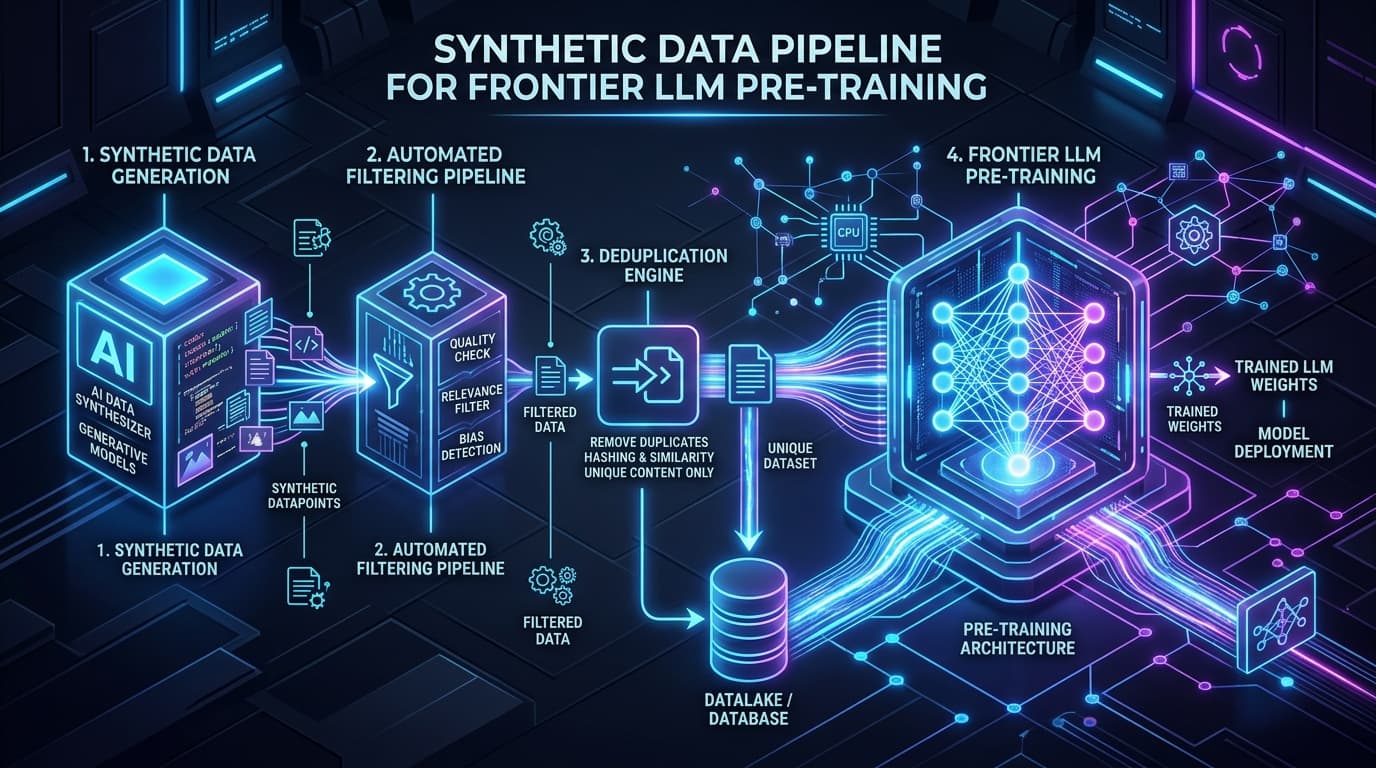
In the scaling of frontier Large Language Models (LLMs), artificial intelligence research has encountered a fundamental boundary known as the "Data Wall." For over a decade, performance gains were driven by scaling model parameter counts and expanding pre-training token volumes scraped from the public internet. However, by mid-2026, the global stock of high-quality, human-generated web text—comprising books, academic literature, code repositories, and high-signal news articles—has been substantially exhausted. Furthermore, data access restrictions, paywalls, and privacy regulations have constrained the availability of uncollected human data.
To sustain parameter scaling and enhance model reasoning capabilities, frontier AI labs have transitioned from passive web scraping to automated Synthetic Data Engineering. Rather than relying exclusively on naturally occurring human text, modern pre-training, instruction tuning, and alignment pipelines generate trillions of synthetic tokens using frontier teacher models, specialized domain generators, and deterministic execution engines.
However, substituting human-generated data with AI-generated outputs introduces significant engineering challenges. Early academic experiments warned of Model Collapse—a catastrophic degenerative feedback loop where recursive training on unfiltered AI output leads to variance degradation, factual hallucinations, and loss of tail-knowledge distribution. Preventing model collapse requires sophisticated data curation architectures, semantic deduplication algorithms, automated verification gates, and dynamic mixture balancing.
This comprehensive guide details the architecture, mathematical considerations, production engineering patterns, benchmark evaluations, and failure modes of integrating synthetic data into pre-training and alignment pipelines for frontier LLMs in 2026.
+-----------------------------------------------------------------------------------+
|                           SYNTHETIC DATA PIPELINE OVERVIEW                        |
+-----------------------------------------------------------------------------------+
|                                                                                   |
|  [ Seed Prompts & Personas ]  -->  [ Multi-Teacher Generators (405B / V3) ]       |
|                                                    |                              |
|                                                    v                              |
|                                    [ Unfiltered Raw Synthetic Pool ]              |
|                                                    |                              |
|                                                    v                              |
|  [ Deterministic Verifiers ]  <--  [ Stage 1: Heuristic & Quality Filtering ]    |
|  (Compilers / REPL / Solvers)                      |                              |
|                                                    v                              |
|                                    [ Stage 2: MinHash & SemDeDup Engine ]         |
|                                                    |                              |
|                                                    v                              |
|  [ Benchmark Audit Engine ]   <--  [ Stage 3: N-Gram Contamination Gate ]          |
|                                                    |                              |
|                                                    v                              |
|                                    [ High-Density Synthetic Dataset ]             |
|                                                    |                              |
|                                                    v                              |
|  [ Human Data Anchor (70%) ]  -->  [ Dynamic Mixture Router & Trainer ]           |
|                                                                                   |
+-----------------------------------------------------------------------------------+
What Is It?
Synthetic data in the context of Large Language Models refers to text, code, mathematical proofs, reasoning traces, or preference pairs programmatically generated by algorithms or artificial intelligence systems rather than directly produced by human authors. In frontier model training pipelines, synthetic data is not a single uniform asset; it is categorized into four primary paradigms based on its structural role in the training lifecycle:
- Pre-Training Augmentation & Rephrasing: High-volume, structured synthetic documents generated to expand pre-training corpora. This includes transforming raw, messy web text into clean educational textbooks, generating domain-specific synthetic technical documentation, and translating code across programming languages.
- Supervised Fine-Tuning (SFT) & Reasoning Traces: High-density instruction-response pairs enriched with explicit Chain-of-Thought (CoT) step-by-step reasoning. Frontier models generate synthetic problem-solving steps for complex mathematical, logical, and software engineering tasks.
- Synthetic Preference Alignment Data: Direct Preference Optimization (DPO) and Reinforcement Learning from Human Feedback (RLHF) datasets composed of prompt, chosen response, and rejected response triplets. These are programmatically generated by ensembling multi-teacher evaluations or execution feedback.
- Execution-Grounded Synthetic Data: Synthetic samples generated alongside deterministic execution feedback from software compilers, Python REPLs, database query engines, or symbolic logic provers. The ground-truth correctness is verified by code execution rather than LLM judging.
+---------------------------------------------------------------------------------------------------+
|                             SYNTHETIC DATA PARADIGM MATRIX                                        |
+----------------------+-----------------------------+-----------------------+----------------------+
| Paradigm             | Generation Source           | Verification Method   | Primary Target       |
+----------------------+-----------------------------+-----------------------+----------------------+
| Pre-Training Text    | 405B Model + Seed Prompts   | MinHash + SemDeDup    | General Knowledge    |
| Reasoning Traces     | CoT Generators + Rejection  | Rule-based Solvers    | Logic & Math SFT     |
| Preference Triplets  | Multi-Teacher Ensembles     | Reward Model (>0.7)   | DPO / KTO Alignment  |
| Execution Code       | LLM Generator + Sandbox     | REPL / Compiler / Unit| Code Generation SFT  |
+----------------------+-----------------------------+-----------------------+----------------------+
Unlike raw internet text, which contains noise, conversational boilerplate, incomplete sentences, and toxic content, optimized synthetic data exhibits high structural density, precise formatting, and explicit logical progression.
Why It Matters
The shift toward synthetic data is driven by fundamental economic, mathematical, and algorithmic requirements in AI development:
1. Surmounting the Web Data Wall
Scaling laws dictate that improving LLM capability requires proportional increases in model parameters and training token volume. Estimates indicate that the usable web data pool peaks at approximately 300 trillion tokens. Beyond this threshold, additional data scraping yields diminishing returns due to repetitive web spam, auto-generated SEO clutter, and non-informative text. Synthetic data pipelines allow AI research labs to construct virtually infinite high-quality tokens tailored to specific domain deficiencies.
2. High-Density Knowledge Curation
Raw web text has low informational density. A standard 10,000-word web page may contain only 200 words of actionable technical knowledge, surrounded by navigation menus, advertisements, and repetitive commentary. Synthetic textbook generation, such as Hugging Face's Cosmopedia project, distills raw facts into concise, highly structured educational documents. Empirical studies demonstrate that pre-training on 25 billion high-density synthetic textbook tokens can match or exceed performance downstream compared to pre-training on 250 billion raw web tokens.
3. Cost and Speed Acceleration
Pre-training frontier models requires massive GPU clusters running for months. Training on noisy data slows down loss convergence, requiring more compute to reach targeted perplexity levels. Integrating high-density synthetic data speeds up pre-training convergence by 5x to 10x per token processed, significantly reducing capital expenditure. For enterprise teams fine-tuning open-weights models, synthetic distillation provides a blueprint to extract frontier performance into smaller models, as detailed in our guide on LLM Distillation.
4. Alignment and Preference Optimization
Aligning models using pure human annotation is expensive, slow, and prone to annotator inconsistency. Synthetic preference generation allows automated generation of millions of verified preference pairs for DPO and KTO algorithms, accelerating post-training alignment as covered in our analysis of RLHF vs DPO Alignment.
| Metric / Dimension | Raw Web Text Scraping | Unfiltered Synthetic Data | Curated & Filtered Synthetic Data |
|---|---|---|---|
| Token Cost (Sourcing) | Low ($0.0001 / 1K tokens) | Moderate ($0.001 / 1K tokens) | High ($0.005 / 1K tokens) |
| Informational Density | Low (5% to 15%) | Variable (20% to 50%) | Extremely High (85% to 95%) |
| Duplicate Content Rate | High (15% to 35%) | Extreme (40% to 70%) | Minimal (<1% via SemDeDup) |
| Model Collapse Risk | Zero | Severe (100% probability) | Managed / Zero (with 70% Human Anchor) |
| Convergence Speedup | Baseline (1.0x) | Degrading (<0.5x) | Accelerated (5.0x to 10.0x) |
How It Works
Building an enterprise-grade synthetic data pipeline requires a multi-stage process to transform raw prompts into verified, non-redundant, high-signal training tokens.
+-----------------------------------------------------------------------------------+
|                         STAGES OF SYNTHETIC DATA GENERATION                       |
+-----------------------------------------------------------------------------------+
|                                                                                   |
|  [ Stage 1: Seed Taxonomy & Persona Expansion ]                                    |
|      - Extract 50,000 topic nodes from OpenStax, Wikipedia, GitHub                |
|      - Assign generation personas (e.g., "Senior Systems Architect", "Professor") |
|                                                                                   |
|  [ Stage 2: Constrained Multi-Teacher Generation ]                                |
|      - Prompt frontier teacher models with temperature decay (T = 0.7 -> 0.2)     |
|      - Force structured markdown, explicit step-by-step reasoning                 |
|                                                                                   |
|  [ Stage 3: Heuristic & Rule-Based Quality Gates ]                                |
|      - Strip system prompt artifacts ("As an AI...", "Certainly!")               |
|      - Reject samples with high repetition rates or invalid syntax                |
|                                                                                   |
|  [ Stage 4: Deterministic Ground-Truth Verification ]                             |
|      - Execute code snippets in sandboxed Python REPL                             |
|      - Evaluate mathematical expressions with Lean 4 / SymPy provers              |
|                                                                                   |
|  [ Stage 5: Dual-Layer Deduplication (MinHash + SemDeDup) ]                       |
|      - MinHash LSH for structural near-duplicates (Jaccard > 0.8)                 |
|      - K-Means embedding clustering for semantic redundancy                       |
|                                                                                   |
|  [ Stage 6: N-Gram Contamination & Benchmark Audit ]                              |
|      - Remove 13-gram overlapping sequences with HumanEval, MMLU, GSM8K           |
|                                                                                   |
+-----------------------------------------------------------------------------------+
Stage 1: Seed Taxonomy and Persona Expansion
To prevent the generator model from repeating the same common topics, pipelines initialize generation using a structured topic tree. Prompts are constructed by combining a topic node (e.g., "Distributed Systems -> Consensus Protocols -> Raft Log Compaction") with specific generation personas (e.g., "Write an in-depth production postmortem written by a Lead Reliability Engineer").
Stage 2: Constrained Multi-Teacher Generation
Generation is executed across an ensemble of distinct frontier models (e.g., Llama 3.1 405B, DeepSeek-V3, Qwen 2.5 72B). System prompts force explicit formatting constraints, step-by-step reasoning traces, and edge-case discussions. Sampling parameters use a moderate temperature (T = 0.7) to encourage diversity, followed by top-p nucleus sampling (top_p = 0.9).
Stage 3: Heuristic & Rule-Based Quality Gates
Raw generated outputs pass through automated regular expression and heuristic filters. Samples containing repetitive token loops, excessive exclamation marks, or LLM system prompt conversational boilerplate ("Certainly! Here is...", "As an AI language model...") are pruned immediately.
Stage 4: Deterministic Ground-Truth Verification
For technical, mathematical, and coding domains, LLM-based judging is insufficient due to hallucination risks. Synthetic outputs are evaluated using deterministic verifiers:
- Code Execution: Python and Rust code blocks are executed in sandboxed environments against unit test suites.
- Math Solvers: Mathematical proofs and calculations are verified using symbolic provers (SymPy, Lean 4) or execution engines.
Stage 5: Dual-Layer Deduplication (MinHash + SemDeDup)
Synthetic generation naturally produces repetitive content structures. Pipelines employ a two-tier deduplication engine:
- MinHash LSH: Detects n-gram structural near-duplicates across text documents.
- SemDeDup (Semantic Deduplication): Computes dense vector embeddings (using models like DeBERTa-v3 or fine-tuned text embedders), clusters documents via K-Means, and removes semantically redundant points that exceed a cosine similarity threshold (
similarity > 0.88).
Stage 6: N-Gram Contamination Audit
To maintain benchmark evaluation integrity, all synthetic documents undergo n-gram overlap checks against popular benchmark datasets (MMLU, GSM8K, MATH, HumanEval, SWE-bench). Any synthetic document sharing more than 13 consecutive identical words with an evaluation test set is flagged and removed.
Architecture
A resilient synthetic data pipeline demands distributed microservice orchestration capable of processing terabytes of generated text per hour. The architecture separates generation workers, verification sandboxes, deduplication clusters, and data storage backends.
+-----------------------------------------------------------------------------------+
|                        DISTRIBUTED SYNTHETIC PIPELINE ARCHITECTURE                |
+-----------------------------------------------------------------------------------+
|                                                                                   |
|    +------------------------+             +------------------------+              |
|    |  Seed Taxonomy Router  |             |  Ray Generation Pool   |              |
|    |  (Kafka / Redis Queue) | ----------> |  (vLLM / TensorRT-LLM) |              |
|    +------------------------+             +------------------------+              |
|                                                       |                           |
|                                                       v                           |
|    +------------------------+             +------------------------+              |
|    |  gRPC REPL Sandbox     | <---------- |  Raw Storage Bucket    |              |
|    |  (Isolated Docker)     |             |  (S3 / MinIO Parquet)  |              |
|    +------------------------+             +------------------------+              |
|                |                                      |                           |
|                v                                      v                           |
|    +---------------------------------------------------------------+              |
|    |         Distributed Spark / Ray Deduplication Cluster         |              |
|    |         - MinHash LSH Indexing                                |              |
|    |         - SemDeDup Cosine Clustering                          |              |
|    +---------------------------------------------------------------+              |
|                                       |                                           |
|                                       v                                           |
|    +---------------------------------------------------------------+              |
|    |         Clean Synthetic Parquet Dataset Storage               |              |
|    +---------------------------------------------------------------+              |
|                                       |                                           |
|                                       v                                           |
|    +---------------------------------------------------------------+              |
|    |         Distributed Pre-Training Pipeline (PyTorch / FSDP)   |              |
|    +---------------------------------------------------------------+              |
|                                                                                   |
+-----------------------------------------------------------------------------------+
Core Architectural Components
- Seed Taxonomy Router: Manages the distribution of prompt trees, domain topics, and generation parameters via high-throughput messaging queues (Apache Kafka or Redis).
- Ray Generation Pool: Orchestrates high-throughput inference across GPU nodes utilizing specialized inference engines (vLLM or TensorRT-LLM) hosting 405B teacher models.
- Execution Sandbox Array: Isolated, ephemeral gRPC microservices running containerized Docker sandboxes. Code execution requests are dispatched safely without compromising host node security.
- Distributed Deduplication Engine: Built on Apache Spark or Ray Data, processing high-dimensional embedding clusters and MinHash signature tables across multi-node memory pools.
The following Python script illustrates a production-grade automated synthetic data filtering and verification pipeline using rule-based heuristics and embedding similarity checks:
import re
import numpy as np
from typing import List, Dict, Any

class SyntheticDataFilterPipeline:
    def __init__(self, min_word_count: int = 150, max_repetition_ratio: float = 0.25):
        self.min_word_count = min_word_count
        self.max_repetition_ratio = max_repetition_ratio

        # Regex patterns for common LLM system prompt artifacts
        self.artifact_patterns = [
            re.compile(r"^certainly!?", re.IGNORECASE),
            re.compile(r"^as an ai language model", re.IGNORECASE),
            re.compile(r"here is a step-by-step breakdown", re.IGNORECASE),
            re.compile(r"in conclusion, it is important to remember", re.IGNORECASE)
        ]

    def check_length_and_artifacts(self, text: str) -> bool:
        """Validate structural token length and check for system prompt boilerplate."""
        words = text.split()
        if len(words) < self.min_word_count:
            return False

        # Check first 100 characters for artifact patterns
        first_100 = text[:100]
        for pattern in self.artifact_patterns:
            if pattern.search(first_100):
                return False
        return True

    def calculate_repetition_rate(self, text: str, n: int = 4) -> float:
        """Calculate n-gram repetition ratio to detect model generation looping."""
        words = text.lower().split()
        if len(words) < n:
            return 0.0

        ngrams = [tuple(words[i:i+n]) for i in range(len(words)-n+1)]
        unique_ngrams = set(ngrams)
        repetition_ratio = 1.0 - (len(unique_ngrams) / len(ngrams))
        return repetition_ratio

    def filter_batch(self, dataset: List[Dict[str, Any]]) -> List[Dict[str, Any]]:
        """Filter a dataset batch using combined heuristic gates."""
        clean_batch = []
        for sample in dataset:
            text = sample.get("text", "")

            # Gate 1: Length and artifact filter
            if not self.check_length_and_artifacts(text):
                continue

            # Gate 2: Repetition check
            if self.calculate_repetition_rate(text) > self.max_repetition_ratio:
                continue

            clean_batch.append(sample)
        return clean_batch

# Example Usage
if __name__ == "__main__":
    raw_samples = [
        {"id": 1, "text": "Certainly! As an AI language model, here is how you write a Raft consensus algorithm in C++..."},
        {"id": 2, "text": "The Raft consensus algorithm maintains state machine replication across a distributed cluster by electing a distinguished leader. The leader manages the append-entries RPC log pipeline... " * 10}
    ]

    pipeline = SyntheticDataFilterPipeline()
    filtered_data = pipeline.filter_batch(raw_samples)
    print(f"Retained {len(filtered_data)} out of {len(raw_samples)} raw samples.")
Production Deployment Considerations
Deploying synthetic data generation and filtering at scale introduces complex operational considerations around infrastructure, tokenizer compatibility, execution security, and hardware allocation.
+-----------------------------------------------------------------------------------+
|                     PRODUCTION DEPLOYMENT CONSIDERATION STACK                     |
+-----------------------------------------------------------------------------------+
|                                                                                   |
|  [ Tokenizer Alignment ]     --> Ensure identical subword tokenization rules      |
|                                  between teacher generator and student model.     |
|                                                                                   |
|  [ Execution Security ]      --> Sandbox synthetic code evaluation via gRPC       |
|                                  and seccomp-restricted Linux containers.         |
|                                                                                   |
|  [ Hardware Optimization ]   --> Balance GPU inference budget (vLLM / H100s)     |
|                                  with downstream pre-training compute cluster.    |
|                                                                                   |
|  [ Data Pipeline Lineage ]   --> Track cryptographic hashes for synthetic tokens |
|                                  to audit training data provenance.              |
|                                                                                   |
+-----------------------------------------------------------------------------------+
1. Tokenizer Vocabulary Alignment
When using a large teacher model (e.g., Llama 3.1 with a 128,000-token vocabulary) to generate synthetic text for a smaller student model with a different tokenizer (e.g., Qwen 2.5 with a 151,643-token vocabulary), subword splitting boundaries alter token density. If the synthetic generator produces code or special control tokens that are invalid in the student model's vocabulary, downstream training will encounter out-of-vocabulary errors or tokenization inefficiency. Tokenizer compatibility must be validated before pre-training, as described in our breakdown of Understanding BPE Tokenizers.
2. Execution Sandbox Security
Evaluating synthetic code or executing generated scripts requires strict sandbox isolation. Raw code generated by LLMs may contain destructive shell commands, memory leaks, or infinite loops. Execution microservices must run inside containerized environments configured with read-only root filesystems, strict memory caps, seccomp system call filters, and zero outbound network access.
3. Compute Allocation Ratios
A common production failure is misallocating compute budgets between generation and pre-training. Generating trillions of synthetic tokens using 405B parameter teacher models requires substantial GPU capacity. Engineering teams must calculate the total cost per token generated versus the convergence efficiency gained during pre-training. A recommended standard is allocating 15% to 20% of the overall GPU compute budget to synthetic generation and filtering, reserving 80% to 85% for model pre-training across distributed infrastructure, aligned with practices in Distributed Training Paradigms.
| Pipeline Gate | Execution Engine | Throughput (Tokens/sec/Node) | Latency Overhead | Rejection Rate (%) |
|---|---|---|---|---|
| Heuristic & Regex Filter | CPU Async Workers | 2,500,000 | <1 ms | 15% to 25% |
| Code REPL Sandbox | gRPC Docker Pool | 45,000 | 120 ms | 30% to 45% |
| MinHash LSH Engine | Distributed Spark | 850,000 | 15 ms | 10% to 20% |
| SemDeDup Embedding Cluster | GPU Tensor Cores | 180,000 | 45 ms | 20% to 35% |
| N-Gram Contamination Check | Rust In-Memory Index | 1,200,000 | 4 ms | 2% to 5% |
Common Mistakes
Engineering teams implementing synthetic data pipelines frequently encounter systemic errors that degrade downstream model capability.
+-----------------------------------------------------------------------------------+
|                            COMMON PIPELINE PITFALLS                               |
+-----------------------------------------------------------------------------------+
|                                                                                   |
|  [ Pitfall 1: Pure Synthetic Replacement ]   --> Leads to catastrophic collapse.   |
|  [ Pitfall 2: Neglecting Semantic Deduplication] -> Causes parameter overfitting. |
|  [ Pitfall 3: System Prompt Artifact Leaks ] --> Prompts leak into outputs.       |
|  [ Pitfall 4: Trivial DPO Preference Pairs ] --> Degenerate reward models.        |
|  [ Pitfall 5: Benchmark Contamination Leak ] --> Inflates benchmark accuracy.     |
|                                                                                   |
+-----------------------------------------------------------------------------------+
1. Completely Replacing Human Web Data
The most severe mistake is replacing human web data entirely with AI-generated text. Recursive training on purely synthetic text without a human data foundation causes model collapse within three to five generation loops. The model loses variance, over-indexes on repetitive output distribution peaks, and exhibits catastrophic factual degradation.
2. Relying Solely on String-Based Deduplication
Standard string matching or exact hash deduplication (such as MD5 or SHA256) fails to detect semantic duplicates in synthetic datasets. Generator models frequently express the exact same technical explanation using slightly different phrasing or sentence structures. Without embedding-based semantic deduplication (SemDeDup), the dataset accumulates redundant information, causing model parameters to overfit on specific stylistic patterns.
3. Leaking System Prompt Conversational Artifacts
Failing to strip conversational introductory boilerplate ("Certainly, here is the explanation...", "As an AI model...") causes downstream models to learn unwanted conversational habits during pre-training. Models pre-trained on uncleaned synthetic text frequently generate unsolicited conversational prefixes during standard inference.
4. Constructing Trivial Synthetic DPO Pairs
In preference optimization pipelines, teams often create negative (rejected) preference examples by simply truncating positive responses or introducing random grammatical errors. Preference optimization models trained on trivial negative examples learn lazy heuristics (such as length bias) rather than acquiring true semantic preference boundaries.
5. Benchmark Contamination via Prompt Expansion
When generating synthetic prompts using web topics, generator models may inadvertently reproduce benchmark questions from MMLU, GSM8K, or SWE-bench contained in their own pre-training weights. Feeding these synthetic prompts back into pre-training data inflates evaluation scores without improving real-world intelligence.
Lessons From Production Deployments
Real-world production runs across frontier labs have yielded empirical strategies for stabilizing synthetic data pipelines.
+-----------------------------------------------------------------------------------+
|                         LESSONS FROM PRODUCTION DEPLOYMENTS                       |
+-----------------------------------------------------------------------------------+
|                                                                                   |
|  Lesson 1: The 70/30 Human-Synthetic Balance Rule                                 |
|            Maintain >= 70% human data anchor; cap synthetic tokens at 30%.        |
|                                                                                   |
|  Lesson 2: Token-Level Editing over Wholesale Generation                          |
|            Edit and refine human web text rather than generating from scratch.    |
|                                                                                   |
|  Lesson 3: Multi-Teacher Architecture Diversity                                   |
|            Combine outputs from distinct model families (Llama, DeepSeek, Qwen).   |
|                                                                                   |
|  Lesson 4: Strict Deterministic Grounding for Technical Domains                   |
|            Only retain synthetic math/code verified by compilers or solvers.      |
|                                                                                   |
+-----------------------------------------------------------------------------------+
Lesson 1: The 70/30 Data Mixture Anchor
Empirical pre-training experiments demonstrate that synthetic data achieves optimal scaling when blended with a substantial human-generated anchor. A pre-training mixture comprising 70% high-quality human web text and 30% curated synthetic data yields optimal performance across reasoning, factual recall, and creative writing. This balance accelerates training convergence while preserving the natural entropy and stylistic variance of human language.
Lesson 2: Token-Level Editing Exceeds Wholesale Generation
Rather than generating long technical documents from scratch using simple prompts, higher signal is achieved via token-level editing and rephrasing. Taking raw human web documents and prompting a teacher model to "correct factual errors, improve technical formatting, and expand step-by-step reasoning" retains the underlying human topic distribution while removing noise and low-quality writing.
Lesson 3: Multi-Teacher Architecture Diversity
Generating an entire synthetic dataset using a single teacher model family (e.g., only Llama 3.1 405B) transfers the inductive biases, formatting quirks, and errors of that specific model into the generated data. Combining synthetic outputs across distinct model families (e.g., Llama 3.1 405B, DeepSeek-V3, and Qwen 2.5 72B) creates a more balanced, robust synthetic corpus.
Lesson 4: Deterministic Grounding is Non-Negotiable for Reasoning
In mathematical reasoning and code synthesis, using an LLM to evaluate the correctness of another LLM's synthetic output introduces high error rates. Production pipelines for DeepSeek-R1 and OpenAI's reasoning models enforce deterministic verifier gates: code must pass 100% of unit test suites, and mathematical derivations must be checked by symbolic execution engines before being admitted into SFT datasets.
| Training Phase | Recommended Synthetic Ratio | Human Anchor Ratio | Primary Generation Target | Key Risk Mitigated |
|---|---|---|---|---|
| Pre-Training Base | 20% to 30% | 70% to 80% | Educational Textbooks & Code | Model Collapse & Perplexity Drift |
| Continued Pre-Training | 40% to 50% | 50% to 60% | Domain Specialization Documents | Knowledge Forgetting |
| Supervised Fine-Tuning | 60% to 80% | 20% to 40% | Step-by-Step CoT Reasoning | Overfitting on Formatting |
| Preference Alignment | 80% to 90% | 10% to 20% | Multi-Teacher Preference Triplets | Reward Hacking & Length Bias |
What Most Articles Miss
Many high-level discussions treat synthetic data as a simple text generation task. However, a deeper mathematical and structural analysis reveals subtle dynamics regarding entropy loss, probability mass concentration, and Mixture-of-Experts (MoE) routing behavior.
1. Mathematical Mechanics of Model Collapse
Model collapse is fundamentally an information-theoretic phenomenon driven by recursive variance loss. When a model Q is trained on synthetic data generated by a previous model P, the probability distribution undergoes mathematical degeneration.
KL Divergence Explosion:
KL(P_human || Q_synthetic) -> Infinity (over recursive generations)
In human text distributions P_human, long-tail facts, colloquialisms, and diverse syntax account for substantial entropy. When model Q_1 samples from P_human, it generates text concentrated around high-probability mode peaks, ignoring low-probability tail events. If model Q_2 is subsequently trained on Q_1's output, it samples from an even narrower distribution peak. Recursively continuing this process shrinks the variance to zero, causing the output probability distribution to collapse onto a singular, repetitive point mass.
HUMAN DATA DISTRIBUTION (High Entropy, Long Tail):
Probability
  ^       .---.
  |      /     \        <-- Preserves tail knowledge & factual diversity
  |  .--'       '--.
  +-------------------> Tokens

SYNTHETIC RECURSIVE COLLAPSE (Zero Variance Mass Concentration):
Probability
  ^        ||
  |        ||           <-- Variance collapses into repetitive mode peaks
  |        ||
  +-------------------> Tokens
Maintaining a non-shrinking 70% human data anchor bounds the Kullback-Leibler (KL) divergence, preventing entropy loss and preserving long-tail factual knowledge.
2. Information Entropy vs. Structural Density Tradeoff
Synthetic data optimization presents a fundamental tradeoff: Information Entropy vs. Structural Density.
High Structural Density  <------------------------->  High Information Entropy
(Clean Formatting, Clear CoT)                        (Unpredictable Nuance, Diverse Vocabulary)
High structural density improves model instruction following and formatting accuracy. However, excessive structural density reduces information entropy, making the model rigid and unable to handle informal human prompts. Effective pipelines balance structural synthetic tokens with high-entropy human tokens.
3. Impact on Mixture-of-Experts (MoE) Router Stability
In modern Mixture-of-Experts architectures, such as DeepSeek-V3 or Mixtral, specialized router networks dynamically assign incoming tokens to specific expert layers. Training MoE models on unverified synthetic data disrupts router load balancing. Because synthetic text exhibits repetitive subword token sequences, specific expert layers receive an oversized portion of tokens, causing parameter under-utilization in other experts. Filtering synthetic datasets for semantic diversity restores uniform expert routing, as analyzed in our overview of Fine-Tuning MoE Routers.
Best Practices
To build a reliable, high-yield synthetic data generation and filtering engine, adhere to these production guidelines:
1. Enforce the 70/30 Human-to-Synthetic Ratio
Never train a pre-training model on pure synthetic text. Maintain a foundation of at least 70% high-quality, deduplicated human web data to anchor entropy and prevent model collapse.
2. Implement Dual-Stage Deduplication
Combine MinHash LSH for structural n-gram near-duplicates with embedding-based SemDeDup clustering for semantic redundancy. Prune candidate synthetic samples whose embedding similarity exceeds 0.88.
3. Anchor Reasoning with Deterministic Verifiers
Do not rely exclusively on LLM-as-a-Judge for mathematical, logical, or software engineering data. Validate ground-truth correctness using compilers, Python REPL sandboxes, and symbolic math engines.
4. Execute Multi-Teacher Ensembling
Generate synthetic corpora using an ensemble of distinct frontier teacher model architectures (e.g., Llama 3.1 405B, DeepSeek-V3, Qwen 2.5 72B) to prevent passing model-specific inductive biases into training data.
5. Audit N-Gram Benchmark Contamination
Run automated 13-gram overlap checks against test suites (MMLU, GSM8K, MATH, HumanEval, SWE-bench). Remove any synthetic document that overlaps with evaluation datasets.
6. Strip System Prompt Artifacts
Filter out conversational introductory phrases ("Certainly!", "As an AI language model...") using automated regex gates before data enters training storage backends.
FAQ
1. What is the difference between synthetic data and distilled data?
Synthetic data refers to any text, code, or preference pair generated programmatically by an AI model or algorithm. Knowledge distillation is a specific subset of synthetic data generation where a smaller "student" model is trained directly on the outputs, step-by-step reasoning traces, or logit distributions of a larger "teacher" model.
2. Does training on synthetic data always cause model collapse?
No. Model collapse occurs primarily when training recursively on purely synthetic text without filtering, deduplication, or human data anchors. When synthetic data is rigorously filtered for quality, semantically deduplicated, and mixed with a 70% human data anchor, it accelerates learning without triggering collapse.
3. How much synthetic data should be used in pre-training?
Industry standard benchmarks recommend capping synthetic data at 20% to 30% of the overall pre-training token mixture. Supervised Fine-Tuning (SFT) and alignment phases can utilize higher synthetic proportions (up to 80%), provided responses are validated by execution verifiers.
4. What is SemDeDup and why is it important for synthetic text?
SemDeDup (Semantic Deduplication) is an algorithm that computes dense embedding representations of text documents, clusters them using K-Means, and removes semantically redundant samples within each cluster. It is critical for synthetic data because generator models often generate identical technical concepts using slightly different wording, which traditional string matching fails to detect.
5. How do research labs verify synthetic math and coding datasets?
Synthetic math and code datasets are verified using deterministic execution engines rather than LLMs. Code snippets are run inside sandboxed environments against unit tests, while mathematical solutions are validated using symbolic provers (SymPy, Lean 4) or execution REPLs.
6. Can synthetic data help small open-source models compete with frontier models?
Yes. High-density synthetic datasets (such as Cosmopedia or distilled reasoning datasets) allow small 8B or 14B parameter models to achieve benchmark performance comparable to much larger legacy models by eliminating noisy, uninformative web text during fine-tuning.
7. How do you prevent synthetic data from leaking benchmark questions?
Pipelines run automated n-gram overlap checks (typically checking for 13 or more consecutive matching words) between synthetic candidate documents and standard evaluation benchmarks (MMLU, HumanEval, GSM8K). Any overlapping document is discarded.
8. What is the impact of synthetic data on Mixture-of-Experts (MoE) models?
Unfiltered synthetic data with repetitive token patterns can cause imbalanced expert routing in MoE models, overloading specific expert networks while under-utilizing others. Filtering synthetic data for semantic diversity ensures uniform token distribution across MoE router layers.
9. What sampling parameters are best for generating synthetic datasets?
A standard configuration uses a moderate temperature (T = 0.7) with nucleus sampling (top_p = 0.9) for initial generation to ensure candidate diversity, followed by temperature decay (T = 0.2) or greedy decoding during verification phases.
10. How does synthetic data affect model quantization performance?
Models pre-trained on clean, structurally consistent synthetic text exhibit smoother activation weight distributions. This reduces outlier activations during inference, leading to lower perplexity degradation when quantizing models to INT4 or FP8 formats, as detailed in our guide on Quantization Mathematics.
Key Takeaways
- Synthetic Data is Essential: With human web data pools plateauing near 300 trillion tokens, synthetic data engineering is necessary to sustain LLM scaling.
- Model Collapse is Preventable: Model collapse is not inevitable; maintaining a 70% human data anchor alongside dual-stage deduplication eliminates recursive variance loss.
- Informational Density Accelerates Convergence: High-density synthetic textbooks accelerate pre-training convergence by 5x to 10x per token compared to noisy web text.
- Deterministic Grounding is Mandatory: Math and code synthetic data must be verified using execution REPLs, compilers, or symbolic provers rather than ungrounded LLM judging.
- Dual-Stage Deduplication is Required: Combining MinHash LSH with embedding-based SemDeDup removes structural and semantic duplicates that bypass exact string hashing.
- Multi-Teacher Diversity Prevents Bias: Ensembling outputs across distinct frontier model architectures prevents transferring single-model inductive biases into synthetic datasets.
- N-Gram Audits Protect Evaluation Integrity: Rigorous 13-gram contamination checks against evaluation suites prevent benchmark data leakage.
- Balance Structural Density and Entropy: Combining high-density synthetic documents with high-entropy human web text ensures models maintain strong formatting discipline without sacrificing factual versatility.